Solved Examples: Integrals

(1.) Evaluate $\displaystyle\int -7dx$


Power Rule

$ \displaystyle\int -7dx \\[5ex] = \displaystyle\int -7 * 1 * dx \\[5ex] 1 = x^0 ...Law\:\:3...Exp \\[3ex] = \displaystyle\int -7x^0dx \\[5ex] = -7 \displaystyle\int x^0dx \\[5ex] = -7 * \dfrac{x^{0 + 1}}{0 + 1} + C \\[5ex] = -7 * \dfrac{x^1}{1} + C \\[5ex] = -7x + C $
(2.) JAMB Evaluate $\displaystyle\int_1^3 (x^2 - 1)dx$

$ A.\:\: -6\dfrac{2}{3} \\[5ex] B.\:\: 6\dfrac{2}{3} \\[5ex] C.\:\: \dfrac{2}{3} \\[5ex] D.\:\: -\dfrac{2}{3} \\[5ex] $

Power Rule

$ \displaystyle\int_1^3 (x^2 - 1)dx \\[5ex] \displaystyle (x^2 - 1)dx = \displaystyle\int x^2dx - \displaystyle\int 1dx \\[5ex] 1 = x^0 ...Law\:\:3...Exp \\[3ex] = \dfrac{x^{2 + 1}}{2 + 1} - \displaystyle\int x^0dx \\[5ex] = \dfrac{x^3}{3} - \dfrac{x^{0 + 1}}{0 + 1} + C \\[5ex] = \dfrac{x^3}{3} - x + C \\[5ex] \rightarrow \\[3ex] \displaystyle\int_1^3 (x^2 - 1)dx = \left[\dfrac{x^3}{3} - x\right]_1^3 \\[5ex] = \left(\dfrac{3^3}{3} - 3\right) - \left(\dfrac{1^3}{3} - 1\right) \\[5ex] = (9 - 3) - \left(\dfrac{1}{3} - \dfrac{3}{3}\right) \\[5ex] = 6 - \left(-\dfrac{2}{3}\right) \\[5ex] = 6 + \dfrac{2}{3} \\[5ex] = 6\dfrac{2}{3} $
(3.) Evaluate $\displaystyle\int (3^p + 7^p)dp$


Standard Integral

$ \displaystyle\int a^x dx = \dfrac{a^x}{\ln a} + C \\[5ex] \displaystyle\int (3^p + 7^p)dp = \displaystyle\int 3^pdp + \displaystyle\int 7^pdp \\[5ex] \displaystyle\int 3^p dx = \dfrac{3^p}{\ln 3} \\[5ex] \displaystyle\int 7^p dx = \dfrac{7^p}{\ln 7} \\[5ex] \rightarrow \\[3ex] \displaystyle\int (3^p + 7^p)dp = \dfrac{3^p}{\ln 3} + \dfrac{7^p}{\ln 7} + C $
(4.) Evaluate $\displaystyle\int (v^{-2} + 8v^{-1})dv$


Power Rule

$ \displaystyle\int (v^{-2} + 8v^{-1})dv \\[5ex] = \displaystyle\int v^{-2}dv + \displaystyle\int 8v^{-1}dv \\[5ex] = \dfrac{v^{-2 + 1}}{-2 + 1} + 8 * \displaystyle\int v^{-1}dv \\[5ex] = \dfrac{v^{-1}}{-1} + 8 * \ln v + C \\[5ex] = -v^{-1} + 8\ln v + C \\[5ex] = -\dfrac{1}{v} + 8\ln v + C \\[5ex] = 8\ln v - \dfrac{1}{v} + C $
(5.)


1st: We shall find the slope of the tangent to the curve at at x = 2.
This is the derivative of the function at x = 2.

2nd: We shall determine the slope of the normal to the curve
The normal to the curve is perpendicular to the tangent to the curve
Hence, the product of the two slopes (product of the slope of the tangent and the slope of the normal) is −1

3rd: We shall determine the point (x1, y1) on the curve
We already know the x-coordinate, but we shall find the y-coordinate

4th: We shall use the Point-Slope Form to determine the equation of the normal to the curve.

$ y = 7x - 5x^2 \\[3ex] \underline{\text{Slope of the tangent to the curve}}, m_T \\[3ex] \dfrac{dy}{dx} = 7 - 10x \\[3ex] @\;x = 2 \\[3ex] m_T = \left.\dfrac{dy}{dx}\right|_{x = 2} \\[5ex] = 7 - 10(2) \\[3ex] = 7 - 20 \\[3ex] = -13 \\[5ex] \underline{\text{Slope of the normal to the curve}}, m_N \\[3ex] m_N * m_T = -1 \\[3ex] m_N * 13 = -1 \\[3ex] m_N = \dfrac{-1}{-13} \\[5ex] m_N = \dfrac{1}{13} \\[5ex] \underline{\text{Point on the curve}}, (x_1, y_1) \\[3ex] y = 7x - 5x^2 \\[3ex] @\;x = 2 \\[3ex] y = 7(2) - 5(2)^2 \\[3ex] = 14 - 5(4) \\[3ex] = 14 - 20 \\[3ex] = -6 \\[3ex] (x_1, y_1) = (2, -6) \\[5ex] \underline{\text{Equation of the normal to the curve}} \\[3ex] \text{Point – Slope Form} \\[3ex] y - y_1 = m_N(x - x_1) \\[4ex] y - -6 = \dfrac{1}{13}(x - 2) \\[5ex] y + 6 = \dfrac{1}{13}x - \dfrac{2}{13} \\[5ex] y = \dfrac{1}{13}x - \dfrac{2}{13} - 6 \\[5ex] y = \dfrac{1}{13}x - \dfrac{2}{13} - \dfrac{78}{13} \\[5ex] y = \dfrac{1}{13}x - \dfrac{80}{13} \\[5ex] LCD = 13 \\[3ex] \text{Multiply each term by 13} \\[3ex] 13y = 13\left(\dfrac{1}{13}x\right) - 13\left(\dfrac{80}{13}\right) \\[5ex] 13y = x - 80 \\[3ex] 13y - x + 80 = 0 $
(6.) Determine the antiderivative of $\cot x$


Integration by Algebraic Substitution

$ \displaystyle\int \cot xdx \\[5ex] \cot x = \dfrac{\cos x}{\sin x}...Quotient\:\:Identity \\[5ex] Let\:\: p = \sin x \\[3ex] \dfrac{dp}{dx} = \cos x \\[5ex] \dfrac{dx}{dp} = \dfrac{1}{\cos x} \\[5ex] dx = \dfrac{dp}{\cos x} \\[5ex] \rightarrow \\[3ex] \displaystyle\int \cot xdx = \displaystyle\int \dfrac{\cos x}{\sin x} dx \\[5ex] = \displaystyle\int \dfrac{\cos x}{p} * \dfrac{dp}{\cos x} \\[5ex] = \displaystyle\int \dfrac{dp}{p} \\[5ex] = \ln p + C \\[3ex] = \ln \sin x + C $
(7.) JAMB Evaluate $\displaystyle\int \sin 3xdx$

$ A.\:\: -\dfrac{1}{3}\cos 3x + c \\[5ex] B.\:\: \dfrac{1}{3}\cos 3x + c \\[5ex] C.\:\: \dfrac{2}{3}\cos 3x + c \\[5ex] C.\:\: -\dfrac{2}{3}\cos 3x + c \\[5ex] $

Integration by Algebraic Substitution

$ \displaystyle\int \sin 3xdx \\[5ex] Let\:\: p = 3x \\[3ex] \dfrac{dp}{dx} = 3 \\[5ex] \dfrac{dx}{dp} = \dfrac{1}{3} \\[5ex] dx = \dfrac{dp}{3} \\[5ex] \rightarrow \\[3ex] \displaystyle\int \sin 3xdx = \displaystyle\int \sin p * \dfrac{dp}{3} \\[5ex] = \dfrac{1}{3} * \displaystyle\int \sin pdp \\[5ex] = \dfrac{1}{3} * -\cos p + C \\[5ex] = \dfrac{1}{3} * - \cos 3x + C \\[3ex] = -\dfrac{1}{3}\cos 3x + c $
(8.) Evaluate $\displaystyle\int \sqrt{2 + \sqrt{x}} dx$


Integration by Algebraic Substitution

$ \displaystyle\int \sqrt{2 + \sqrt{x}} dx \\[3ex] Let\:\: p = 2 + \sqrt{x} \\[3ex] \dfrac{dp}{dx} = \dfrac{1}{2\sqrt{x}} \\[5ex] \dfrac{dx}{dp} = 2\sqrt{x} \\[5ex] dx = 2\sqrt{x}dp \\[3ex] \rightarrow \\[3ex] \displaystyle\int \sqrt{2 + \sqrt{x}} dx = \displaystyle\int \sqrt{p} * 2\sqrt{x} dp \\[3ex] = 2\displaystyle\int \sqrt{p} * \sqrt{x} dp \\[3ex] p = 2 + \sqrt{x} \rightarrow \sqrt{x} = p - 2 \\[3ex] = 2 * \displaystyle\int \sqrt{p}(p - 2) dp \\[3ex] \displaystyle\int \sqrt{p}(p - 2) dp = \displaystyle\int p\sqrt{p}dp - \displaystyle\int 2\sqrt{p}dp \\[3ex] \displaystyle\int p\sqrt{p}dp = \displaystyle\int p^1 * p^{\dfrac{1}{2}}dp = \displaystyle\int p^{1 + \dfrac{1}{2}}dp = \displaystyle\int p^{\dfrac{3}{2}}dp \\[5ex] \displaystyle\int p\sqrt{p}dp = \dfrac{p^{\dfrac{3}{2} + 1}}{\dfrac{3}{2} + 1} \\[7ex] \displaystyle\int p\sqrt{p}dp = p^{\dfrac{5}{2}} \div \dfrac{5}{2} \\[5ex] \displaystyle\int p\sqrt{p}dp = p^{\dfrac{5}{2}} * \dfrac{2}{5} \\[5ex] p^{\dfrac{5}{2}} = (\sqrt{p})^5 = (\sqrt{p})^4 * \sqrt{p} = \left(p^{\dfrac{1}{2}}\right)^4 * \sqrt{p} = p^2\sqrt{p} \\[5ex] \displaystyle\int p\sqrt{p}dp = \dfrac{2p^2}{5} \\[5ex] \displaystyle\int 2\sqrt{p}dp = 2\displaystyle\int \sqrt{p}dp \\[3ex] \displaystyle\int \sqrt{p}dp = \dfrac{p^{\dfrac{1}{2} + 1}}{\dfrac{1}{2} + 1} \\[7ex] \displaystyle\int \sqrt{p}dp = p^{\dfrac{3}{2}} \div \dfrac{3}{2} \\[5ex] \displaystyle\int \sqrt{p}dp = p^{\dfrac{3}{2}} * \dfrac{2}{3} \\[5ex] p^{\dfrac{3}{2}} = (\sqrt{p})^3 = (\sqrt{p})^2 * \sqrt{p} = \left(p^{\dfrac{1}{2}}\right)^2 * \sqrt{p} = p\sqrt{p} \\[5ex] \displaystyle\int 2\sqrt{p}dp = \dfrac{2p\sqrt{p}}{3} \\[5ex] \rightarrow \\[3ex] displaystyle\int \sqrt{p}(p - 2) dp = \dfrac{2p^2\sqrt{p}}{5} - \dfrac{2p\sqrt{p}}{3} \\[5ex] = 2p\sqrt{p}\left(\dfrac{p}{5} - \dfrac{1}{3}\right) \\[5ex] = 2p\sqrt{p}\left(\dfrac{3p}{15} - \dfrac{5}{15}\right) \\[5ex] = 2p\sqrt{p}\left(\dfrac{3p - 5}{15}\right) \\[5ex] \rightarrow \\[3ex] 2 * \displaystyle\int \sqrt{p}(p - 2) dp = 2 * 2p\sqrt{p}\left(\dfrac{3p - 5}{15}\right) \\[5ex] = 4p\sqrt{p}\left(\dfrac{3p - 5}{15}\right) \\[5ex] Substitute\:\:back \\[3ex] = 4(2 + \sqrt{x})\sqrt{2 + \sqrt{x}}\left(\dfrac{3(2 + \sqrt{x}) - 5}{15}\right) \\[5ex] \dfrac{3(2 + \sqrt{x}) - 5}{15} = \dfrac{6 + 3\sqrt{x} - 5}{15} = \dfrac{1 + 3\sqrt{x}}{15} \\[5ex] \rightarrow \\[3ex] displaystyle\int \sqrt{2 + \sqrt{x}} dx = 4(2 + \sqrt{x})\left(\sqrt{2 + \sqrt{x}}\right)\left(\dfrac{1 + 3\sqrt{x}}{15}\right) \\[5ex] \therefore \displaystyle\int \sqrt{2 + \sqrt{x}} dx = \dfrac{4}{15}(2 + \sqrt{x})(1 + 3\sqrt{x})\left(\sqrt{2 + \sqrt{x}}\right) + C $
(9.) Find the integral of $\tan x$


Integration by Algebraic Substitution

$ \displaystyle\int \tan xdx \\[5ex] \tan x = \dfrac{\sin x}{\cos x}...Quotient\:\:Identity \\[5ex] Let\:\: p = \cos x \\[3ex] \dfrac{dp}{dx} = -\sin x \\[5ex] \dfrac{dx}{dp} = -\dfrac{1}{\sin x} \\[5ex] dx = -\dfrac{dp}{\sin x} \\[5ex] \rightarrow \\[3ex] \displaystyle\int \tan xdx = \displaystyle\int \dfrac{\sin x}{\cos x} dx \\[5ex] = \displaystyle\int \dfrac{\sin x}{p} * -\dfrac{dp}{\sin x} \\[5ex] = \displaystyle\int -\dfrac{dp}{p} \\[5ex] = -\ln p + C \\[3ex] = -\ln \cos x + C $
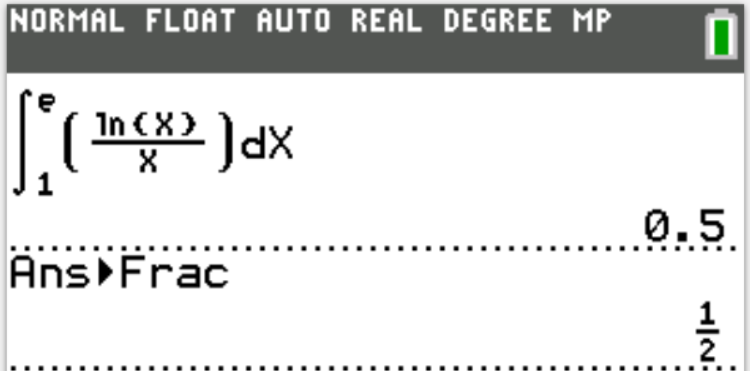
(10.) Evaluate $\displaystyle\int_1^e \dfrac{\ln x}{x} dx$


$ \displaystyle\int_1^e \dfrac{\ln x}{x} dx \\[5ex] \underline{\text{Integration by Algebraic Substitution}} \\[3ex] \text{Let } p = \ln x \\[3ex] \dfrac{dp}{dx} = \dfrac{1}{x} \\[5ex] \dfrac{dx}{dp} = x \\[5ex] dx = xdp \\[3ex] \implies \\[3ex] \displaystyle\int \dfrac{p}{x} * x dp \\[5ex] = \displaystyle\int p dp \\[3ex] = \dfrac{p^2}{2} \\[5ex] = \dfrac{(\ln x)^2}{2} \\[5ex] \left[\dfrac{(\ln x)^2}{2}\right]_1^e \\[5ex] = \dfrac{1}{2}[(\ln x)^2]_1^e \\[5ex] = \dfrac{1}{2}[(\ln e)^2 - (\ln 1)^2] \\[5ex] = \dfrac{1}{2}[1^2 - 0^2] \\[5ex] = \dfrac{1}{2}[1 - 0] \\[5ex] = \dfrac{1}{2} $

Calculator10
(11.) WASSCE:FM Evaluate $\displaystyle\int_0^1 \dfrac{3 - 3x^2}{x + 1}dx$

$ A.\:\: 1\dfrac{1}{3} \\[5ex] B.\:\: 1\dfrac{1}{2} \\[5ex] C.\:\: 3 \\[3ex] D.\:\: 4\dfrac{1}{2} \\[5ex] $

Power Rule

$ \displaystyle\int_0^1 \dfrac{3 - 3x^2}{x + 1}dx \\[5ex] 3 - 3x^2 = 3(1 - x^2) \\[3ex] 1 - x^2 = 1^2 - x^2 = (1 + x)(1 - x)...Difference\:\:of\:\:Two\:\:Squares \\[3ex] 3 - 3x^2 = 3(1 + x)(1 - x) = 3(x + 1)(1 - x) \\[3ex] \rightarrow \\[3ex] \dfrac{3 - 3x^2}{x + 1} = \dfrac{3(x + 1)(1 - x)}{x + 1} = 3(1 - x) = 3 - 3x \\[5ex] \rightarrow \\[3ex] \displaystyle\int (3 - 3x)dx = \displaystyle\int 3dx - \displaystyle\int 3xdx \\[5ex] \displaystyle\int 3dx = 3x \\[5ex] \displaystyle\int 3xdx = 3 * \dfrac{x^{1 + 1}}{1 + 1} = \dfrac{3x^2}{2} \\[5ex] \rightarrow \\[3ex] \displaystyle\int_0^1 \dfrac{3 - 3x^2}{x + 1}dx = \left[3x - \dfrac{3x^2}{2}\right]_0^1 \\[5ex] = \left[3(1) - \dfrac{3(1)^2}{2}\right] - \left[3(0) - \dfrac{3(0)^2}{2}\right] \\[5ex] = \left[3 - \dfrac{3(1)}{2}\right] - \left[0 - \dfrac{3(0)}{2}\right] \\[5ex] = \left(3 - \dfrac{3}{2}\right) - \left(0 - \dfrac{0}{2}\right) \\[5ex] = \left(\dfrac{6}{2} - \dfrac{3}{2}\right) - (0 - 0) \\[5ex] = \dfrac{6 - 3}{2} - 0 \\[5ex] = \dfrac{3}{2} \\[5ex] = 1\dfrac{1}{2} $
(12.) ATAR (a) Given that $\dfrac{2}{(x + 1)(x - 1)} = \dfrac{a}{x - 1} + \dfrac{b}{x + 1}$

determine the values for a and b

(b) Hence determine $\displaystyle\int \dfrac{1}{x^2 - 1}dx$


Numerator: cannot be simplified further

Form: Proper Fraction: Non-repeated Linear Factors at the Denominator

$ \dfrac{2}{(x + 1)(x - 1)} \\[5ex] = \dfrac{a}{x - 1} + \dfrac{b}{x + 1} \\[5ex] = \dfrac{a(x + 1) + b(x - 1)}{(x - 1)(x + 1)} \\[5ex] = \dfrac{ax + a + bx - b}{(x - 1)(x + 1)} \\[5ex] = \dfrac{ax + bx + a - b}{(x - 1)(x + 1)} \\[5ex] $ Denominators are the same
Equate the numerators

$ 2 = ax + bx + a - b \\[3ex] ax + bx + a - b = 2 \\[3ex] ax + bx + a - b = 0x + 2 \\[3ex] \implies \\[3ex] a + b = 0 ...eqn.(1) \\[3ex] a - b = 2 ...eqn.(2) \\[3ex] eqn.(1) + eqn.(2) \implies \\[3ex] 2a = 2 \\[3ex] a = \dfrac{2}{2} \\[5ex] a = 1 \\[3ex] eqn.(1) - eqn.(2) \implies \\[3ex] 2b = -2 \\[3ex] b = -\dfrac{2}{2} \\[5ex] b = -1 \\[3ex] \therefore \dfrac{2}{(x + 1)(x - 1)} = \dfrac{1}{x - 1} + \dfrac{-1}{x + 1} \\[5ex] \dfrac{2}{(x - 1)(x + 1)} = \dfrac{1}{x - 1} - \dfrac{1}{x + 1} \\[5ex] \underline{Check} \\[3ex] \underline{RHS} \\[3ex] \dfrac{1}{x - 1} - \dfrac{1}{x + 1} \\[5ex] = \dfrac{1(x + 1) - 1(x - 1)}{(x - 1)(x + 1)} \\[5ex] = \dfrac{x + 1 - x + 1}{(x - 1)(x + 1)} \\[5ex] = \dfrac{2}{(x - 1)(x + 1)} \\[5ex] = \dfrac{2}{(x + 1)(x - 1)} \\[5ex] = LHS \\[3ex] $ Integration by Partial Fractions

(b) Because of the word, "Hence"; we are expected to use the result we got from Part (a) to solve Part (b)
However, the partial fraction we did in (a) is slightly different from the integral in (b)
So, we need to make some modifications in order to solve it.

$ \displaystyle\int \dfrac{1}{x^2 - 1}dx \\[5ex] \underline{Denominator} \\[3ex] x^2 - 1 = (x + 1)(x - 1) ...Difference\;\;of\;\;Two\;\;Squares \\[3ex] \displaystyle\int \dfrac{1}{x^2 - 1}dx \\[5ex] = \displaystyle\int \dfrac{1}{(x + 1)(x - 1)} dx \\[5ex] = \dfrac{1}{2} * \displaystyle\int \dfrac{2}{(x + 1)(x - 1)} dx \\[5ex] = \dfrac{1}{2} * \left[\displaystyle\int \left(\dfrac{1}{x - 1} - \dfrac{1}{x + 1}\right) dx\right] \\[5ex] = \dfrac{1}{2} * \left[\displaystyle\int \dfrac{1}{x - 1}dx - \displaystyle\int \dfrac{1}{x + 1}dx\right] \\[5ex] = \dfrac{1}{2}[\ln|x - 1| - \ln|x + 1|] + C \\[5ex] = \dfrac{1}{2}\ln\dfrac{|x - 1|}{|x + 1|} + C $
(13.)


(14.) WASSCE:FM

(a) Express $\dfrac{x + 6}{(x + 1)^3}$ in partial fractions

(b) Use the answer in (a) to evaluate $\displaystyle\int_1^2 \dfrac{x + 6}{(x + 1)^3}dx$


$ (a.) \\[3ex] \dfrac{x + 6}{(x + 1)^3} \\[5ex] $ Numerator: cannot be simplified further
Denominator: cannot be simplified further
Form: Proper Fraction: Repeated Linear Factors at the Denominator

$ \dfrac{x + 6}{(x + 1)^3} \\[5ex] = \dfrac{A}{x + 1} + \dfrac{B}{(x + 1)^2} + \dfrac{C}{(x + 1)^3} \\[5ex] = \dfrac{A(x + 1)^2 + B(x + 1) + C}{(x + 1)^3} \\[5ex] = \dfrac{A[(x + 1)(x + 1)] + Bx + B + C}{(x + 1)^3} \\[5ex] = \dfrac{A[x^2 + x + x + 1] + Bx + B + C}{(x + 1)^3} \\[5ex] = \dfrac{A[x^2 + 2x + 1] + Bx + B + C}{(x + 1)^3} \\[5ex] = \dfrac{Ax^2 + 2Ax + A + Bx + B + C}{(x + 1)^3} \\[5ex] = \dfrac{Ax^2 + 2Ax + Bx + A + B + C}{(x + 1)^3} \\[5ex] $ Denominators are the same
Equate the numerators

$ x + 6 = Ax^2 + 2Ax + Bx + A + B + C \\[3ex] Swap \\[3ex] Ax^2 + 2Ax + Bx + A + B + C = x + 6 \\[3ex] Ax^2 + x(2A + B) + A + B + C = 0x^2 + x + 6 \\[3ex] \implies \\[3ex] A = 0...eqn.(1) \\[3ex] 2A + B = 1...eqn.(2) \\[3ex] A + B + C = 6...eqn.(3) \\[3ex] Substitute\;\;eqn.(1)\;\;in\;\;eqn.(2) \\[3ex] 2(0) + B = 1 \\[3ex] 0 + B = 1 \\[3ex] B = 1 - 0 \\[3ex] B = 1 \\[3ex] Substitute\;\;0\;\;for\;\;A\;\;and\;\;1\;\;for\;\;B\;\;in\;\;eqn.(3) \\[3ex] 0 + 1 + C = 6 \\[3ex] 1 + C = 6 \\[3ex] C = 6 - 1 \\[3ex] C = 5 \\[3ex] \implies \\[3ex] \dfrac{x + 6}{(x + 1)^3} = \dfrac{0}{x + 1} + \dfrac{1}{(x + 1)^2} + \dfrac{5}{(x + 1)^3} \\[5ex] \dfrac{x + 6}{(x + 1)^3} = 0 + \dfrac{1}{(x + 1)^2} + \dfrac{5}{(x + 1)^3} \\[5ex] \therefore \dfrac{x + 6}{(x + 1)^3} = \dfrac{1}{(x + 1)^2} + \dfrac{5}{(x + 1)^3} \\[5ex] \underline{Check} \\[3ex] \dfrac{x + 6}{(x + 1)^3} = \dfrac{1}{(x + 1)^2} + \dfrac{5}{(x + 1)^3} \\[5ex] \underline{RHS} \\[3ex] \dfrac{1}{(x + 1)^2} + \dfrac{5}{(x + 1)^3} \\[5ex] = \dfrac{1(x + 1) + 5}{(x + 1)^3} \\[5ex] = \dfrac{x + 1 + 5}{(x + 1)^3} \\[5ex] = \dfrac{x + 6}{(x + 1)^3} \\[5ex] = LHS \\[3ex] $ Integration by Partial Fractions

$ (b.) \\[3ex] \displaystyle\int_1^2 \dfrac{x + 6}{(x + 1)^3} dx \\[5ex] = \displaystyle\int_1^2 \left[\dfrac{1}{(x + 1)^2} + \dfrac{5}{(x + 1)^3}\right] dx \\[5ex] = \displaystyle\int_1^2 \dfrac{1}{(x + 1)^2} dx + \displaystyle\int_1^2 \dfrac{5}{(x + 1)^3} dx \\[5ex] Let\;\; p = x + 1 \\[3ex] \dfrac{dp}{dx} = 1 \\[5ex] \dfrac{dx}{dp} = \dfrac{1}{1} = 1 \\[5ex] dx = dp \\[3ex] \displaystyle\int \dfrac{1}{(x + 1)^2} dx \\[5ex] = \displaystyle\int \dfrac{1}{p^2} dp \\[5ex] = \displaystyle\int p^{-2} dp \\[5ex] = \dfrac{p^{-2 + 1}}{-2 + 1} \\[5ex] = \dfrac{p^{-1}}{-1} \\[5ex] = -p^{-1} \\[3ex] = -\dfrac{1}{p} \\[5ex] = -\dfrac{1}{x + 1} \\[5ex] \implies \\[3ex] \displaystyle\int_1^2 \dfrac{1}{(x + 1)^2} dx \\[5ex] = \left[-\dfrac{1}{x + 1}\right]_1^2 \\[5ex] = -\dfrac{1}{2 + 1} - -\dfrac{1}{1 + 1} \\[5ex] = -\dfrac{1}{3} + \dfrac{1}{2} \\[5ex] = \dfrac{-2 + 3}{6} \\[5ex] = \dfrac{1}{6} \\[7ex] \displaystyle\int \dfrac{5}{(x + 1)^3} dx \\[5ex] = 5\displaystyle\int \dfrac{1}{(x + 1)^3} dx \\[5ex] = 5\displaystyle\int \dfrac{1}{p^3} dp \\[5ex] = 5\displaystyle\int p^{-3} dp \\[5ex] = 5 * \dfrac{p^{-3 + 1}}{-3 + 1} \\[5ex] = 5 * \dfrac{p^{-2}}{-2} \\[5ex] = -\dfrac{5}{2} * p^{-2} \\[5ex] = -\dfrac{5}{2} * \dfrac{1}{p^2} \\[5ex] = -\dfrac{5}{2p^2} \\[5ex] = -\dfrac{5}{2(x + 1)^2} \\[5ex] \implies \\[3ex] \displaystyle\int_1^2 \dfrac{5}{(x + 1)^3} dx \\[5ex] = \left[-\dfrac{5}{2(x + 1)^2}\right]_1^2 \\[5ex] = -\dfrac{5}{2(2 + 1)^2} - -\dfrac{5}{2(1 + 1)^2} \\[5ex] = -\dfrac{5}{2(3)^2} + \dfrac{5}{2(2)^2} \\[5ex] = -\dfrac{5}{2(9)} + \dfrac{5}{2(4)} \\[5ex] = -\dfrac{5}{18} + \dfrac{5}{8} \\[5ex] = \dfrac{-20 + 45}{72} \\[5ex] = \dfrac{25}{72} \\[7ex] \implies \\[3ex] \displaystyle\int_1^2 \dfrac{1}{(x + 1)^2} dx + \displaystyle\int_1^2 \dfrac{5}{(x + 1)^3} dx \\[5ex] = \dfrac{1}{6} + \dfrac{25}{72} \\[5ex] = \dfrac{12 + 25}{72} \\[5ex] = \dfrac{37}{72} \\[5ex] \therefore \displaystyle\int_1^2 \dfrac{x + 6}{(x + 1)^3} dx = \dfrac{37}{72} $
(15.) Cambridge:O-Level (a.) Evaluate $\displaystyle\int_{\dfrac{\pi}{3}}^{\dfrac{\pi}{2}} \cos \dfrac{x}{4}dx$
You must show all your working.

(b.) Find $\displaystyle\int\left(\dfrac{1}{4x - 3} + \dfrac{1}{x^3}\right) dx$


$ (a.) \\[3ex] \displaystyle\int_{\dfrac{\pi}{3}}^{\dfrac{\pi}{2}} \cos \dfrac{x}{4}dx \\[5ex] ..................................................................... \\[3ex] \displaystyle\int \cos \dfrac{x}{4}dx \\[5ex] = \dfrac{1}{4} \displaystyle\int \cos x dx \\[5ex] = \dfrac{1}{4}\sin x + C \\[5ex] ..................................................................... \\[3ex] \implies \\[3ex] = \dfrac{1}{4}\left(\sin\dfrac{\pi}{2} - \sin\dfrac{\pi}{3}\right) \\[5ex] = \dfrac{1}{4}\left(1 - \dfrac{\sqrt{3}}{2}\right) \\[5ex] = \dfrac{1}{4}\left(\dfrac{2 - \sqrt{3}}{2}\right) \\[5ex] = \dfrac{2 - \sqrt{3}}{8} \\[5ex] (b.) \\[3ex] \displaystyle\int\left(\dfrac{1}{4x - 3} + \dfrac{1}{x^3}\right) dx \\[5ex] = \displaystyle\int\dfrac{1}{4x - 3} dx + \displaystyle\int\dfrac{1}{x^3}dx \\[5ex] ..................................................................... \\[3ex] \text{For } \displaystyle\int\dfrac{1}{4x - 3} dx \\[5ex] \underline{\text{Integration by Algebraic Substitution}} \\[3ex] \text{Let } p = 4x - 3 \\[3ex] \dfrac{dp}{dx} = 4 \\[5ex] \dfrac{dx}{dp} = \dfrac{1}{4} \\[5ex] dx = \dfrac{dp}{4} \\[5ex] \implies \\[3ex] \displaystyle\int \dfrac{1}{p} * \dfrac{dp}{4} \\[5ex] = \dfrac{1}{4} \displaystyle\int \dfrac{dp}{p} \\[5ex] = \dfrac{1}{4}\ln p \\[5ex] = \dfrac{1}{4}\ln(4x + 3) \\[5ex] \text{For } \displaystyle\int\dfrac{1}{x^3}dx \\[5ex] = \displaystyle\int x^{-3} dx \\[5ex] = \dfrac{x^{-3 + 1}}{-3 + 1} \\[5ex] = \dfrac{x^{-2}}{-2} \\[5ex] = -\dfrac{1}{2} * \dfrac{1}{x^2} \\[5ex] = -\dfrac{1}{2x^2} \\[5ex] ..................................................................... \\[3ex] \implies \\[3ex] \displaystyle\int\dfrac{1}{4x - 3} dx + \displaystyle\int\dfrac{1}{x^3}dx \\[5ex] = \dfrac{1}{4}\ln(4x + 3) -\dfrac{1}{2x^2} + C $
(16.) Integrate:
(a.) $\displaystyle\int x^3 + 3x^2 - 4x + 5 + \dfrac{2}{x} - \dfrac{3}{x^2} dx$

(b.) $\displaystyle\int xe^{3x^2} dx$

(c.) Check your answer for part (b.) using a method independent of the integration.
Make sure your notation clearly tells what you are doing.


C is the integration constant.

$ (a.) \\[3ex] \text{Power Rule, Constant Multiple Rule and Logarithmic Integration Rule} \\[3ex] \displaystyle\int x^3 + 3x^2 - 4x + 5 + \dfrac{2}{x} - \dfrac{3}{x^2} dx \\[5ex] = \displaystyle\int x^3 + 3x^2 - 4x + 5 + 2x^{-1} - 3x^{-2} dx \\[5ex] = \dfrac{x^4}{4} + \dfrac{3x^3}{3} - \dfrac{4x^2}{2} + 5x + 2\ln|x| - \dfrac{3x^{-1}}{-1} \\[5ex] = \dfrac{x^4}{4} + x^3 - 2x^2 + 5x + 2\ln|x| + \dfrac{3}{x} + C \\[5ex] (b.) \\[3ex] \text{Integration by Algebraic Substitution} \\[3ex] \displaystyle\int xe^{3x^2} dx \\[3ex] \text{Let } p = 3x^2 \\[3ex] \dfrac{dp}{dx} = 6x \\[5ex] \dfrac{dx}{dp} = \dfrac{1}{6x} \\[5ex] dx = \dfrac{dp}{6x} \\[5ex] \implies \\[3ex] \displaystyle\int xe^{p} * \dfrac{dp}{6x} \\[5ex] = \dfrac{1}{6} \displaystyle\int e^p dp \\[5ex] = \dfrac{e^p}{6} \\[5ex] = \dfrac{e^{3x^2}}{6} + C \\[5ex] $ (c.) When you integrate a function with respect to x (in other words, when you integrate the integrand), the result is known as the antiderivative (or integral) of the function with respect to x (wrt x).
When you differentiate the antiderivative wrt x, you get back the function.
So, let us differentiate the antiderivative of the function wrt x.

$ \text{Let } F(x) = \dfrac{e^{3x^2}}{6} \\[5ex] F(x) = \dfrac{1}{6} * e^{3x^2} + C \\[5ex] \text{Let } u = \dfrac{1}{6} \hspace{4em} v = e^{3x^2} \\[5ex] ................................................................. \\[3ex] v = e^{3x^2} \\[3ex] \text{Let }k = 3x^2 \hspace{2em}\implies \hspace{2em} v = e^k \\[3ex] \dfrac{dk}{dx} = 6x \hspace{7em} \dfrac{dv}{dk} = e^k \\[5ex] \dfrac{dv}{dx} = \dfrac{dv}{dk} * \dfrac{dk}{dx} ...\text{Function of a Function Rule} \\[5ex] \dfrac{dv}{dx} = e^k * 6x \\[5ex] \dfrac{dv}{dx} = 6xe^{3x^2} \\[5ex] ................................................................. \\[3ex] \dfrac{du}{dx} = 0 \hspace{6em} \dfrac{dv}{dx} = 6xe^{3x^2} \\[5ex] F'(x) = u\dfrac{dv}{dx} + v\dfrac{du}{dx} ...\text{Product Rule} \\[5ex] F'(x) = \dfrac{1}{6} * 6xe^{3x^2} + e^{3x^2} * 0 \\[5ex] f(x) = F'(x) = xe^{3x^2}...\text{This is the integrand in Part (b.)} $
(17.) Evaluate $\displaystyle\int \dfrac{1}{\sqrt{9 - x^2}} dx$


Standard Integral: Trigonometric Substitution

$ \displaystyle\int \dfrac{dx}{\sqrt{a^2 - x^2}} = \sin^{-1}\left(\dfrac{x}{a}\right) + C \\[5ex] For:\;\;\displaystyle\int \dfrac{1}{\sqrt{9 - x^2}} dx \\[5ex] Compare:\;\;a^2 - x^2 \;\;to\;\; 9 - x^2 \\[3ex] a^2 = 9 \\[3ex] a = \sqrt{9} \\[3ex] a = 3 \\[3ex] \implies \\[3ex] \displaystyle\int \dfrac{1}{\sqrt{9 - x^2}} dx \\[5ex] = \sin^{-1}\left(\dfrac{x}{3}\right) + C $
(18.) Integrate $xe^x$ with respect to x


Integration by Parts

$ \displaystyle\int udv = uv - \displaystyle\int vdu \\[3ex] \displaystyle\int xe^x dx \\[3ex] Let\;\;u = x \qquad\qquad\qquad dv = e^x dx \\[3ex] \dfrac{du}{dx} = 1 \qquad\qquad\qquad\quad v = \displaystyle\int e^x dx \\[5ex] du = dx \qquad\qquad\qquad\quad v = e^x \\[3ex] = x(e^x) - \displaystyle\int e^x dx \\[5ex] = xe^x - e^x + C \\[3ex] = e^x(x - 1) + C $
(19.) Determine the indefinite integral $\displaystyle\int \dfrac{2dt}{\sqrt{16 - 36t^2}}$


Standard Integral: Trigonometric Substitution

$ \displaystyle\int \dfrac{dx}{\sqrt{a^2 - x^2}} = \sin^{-1}\left(\dfrac{x}{a}\right) + C \\[5ex] For:\;\;\displaystyle\int \dfrac{2dt}{\sqrt{16 - 36t^2}} \\[5ex] $ (1.) The coefficient of $t^2$ is not unity. We need to make it unity (make it 1)
(2.) We need to simplify the integral to look like the standard integral

$ \displaystyle\int \dfrac{2dt}{\sqrt{16 - 36t^2}} \\[5ex] = \displaystyle\int \dfrac{2dt}{\sqrt{36\left(\dfrac{16}{36} - t^2\right)}} \\[10ex] = \displaystyle\int \dfrac{2dt}{6\sqrt{\dfrac{4}{9} - t^2}} \\[10ex] = \dfrac{2}{6} \displaystyle\int \dfrac{dt}{\sqrt{\dfrac{2^2}{3^2} - t^2}} \\[10ex] = \dfrac{1}{3} \displaystyle\int \dfrac{dt}{\sqrt{\left(\dfrac{2}{3}\right)^2 - t^2}} \\[10ex] Compare:\;\;a^2 - x^2 \;\;to\;\;\left(\dfrac{2}{3}\right)^2 - t^2 \\[5ex] a = \dfrac{2}{3} \\[5ex] x = t \\[3ex] \implies \\[3ex] = \dfrac{1}{3}\sin^{-1}\left(t \div \dfrac{2}{3}\right) + C \\[5ex] = \dfrac{1}{3}\sin^{-1}\left(\dfrac{3t}{2}\right) + C $
(20.) Evaluate the definite integral:

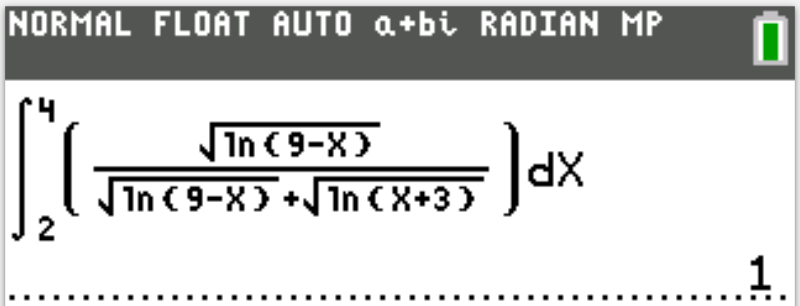
$ \displaystyle\int_{4}^{2} \dfrac{\sqrt{\ln(9 - x)}}{\sqrt{\ln(9 - x)} + \sqrt{\ln(x + 3)}} dx \\[5ex] $

$ \displaystyle\int_{2}^{4} \dfrac{\sqrt{\ln(9 - x)}}{\sqrt{\ln(9 - x)} + \sqrt{\ln(x + 3)}} dx \text{ is of the form}: \;\; \displaystyle\int_a^b \dfrac{f(x_1)}{f(x_1) + f(x_2)}dx \\[7ex] $ So, we shall solve it by Functional Transformation in Integration

$ \underline{\text{Original Integral}} \\[3ex] Let\;\;I_1 = \displaystyle\int_{2}^{4} \dfrac{\sqrt{\ln(9 - x)}}{\sqrt{\ln(9 - x)} + \sqrt{\ln(x + 3)}} dx \\[7ex] \underline{\text{Tranformed Function}} \\[3ex] Set\;\; x = (4 + 2) - x \\[3ex] x = 6 - x \\[5ex] 9 - x \\[3ex] = 9 - (6 - x) \\[3ex] = 9 - 6 + x \\[3ex] = 3 + x \\[3ex] = x + 3 \\[5ex] x + 3 \\[3ex] = 6 - x + 3 \\[3ex] = 9 - x \\[5ex] \underline{\text{Transformed Integral}} \\[3ex] Let\;\;I_2 = \displaystyle\int_{2}^{4} \dfrac{\sqrt{\ln(9 - x)}}{\sqrt{\ln(9 - x)} + \sqrt{\ln(x + 3)}} dx \\[7ex] = \displaystyle\int_{2}^{4} \dfrac{\sqrt{\ln(x + 3)}}{\sqrt{\ln(x + 3)} + \sqrt{\ln(9 - x)}} dx \\[7ex] I_1 = I_2 = \text{the integral},\; I \\[3ex] I_1 + I_2 = I + I = 2I \\[3ex] 2I \\[3ex] = \displaystyle\int_{2}^{4} \dfrac{\sqrt{\ln(9 - x)}}{\sqrt{\ln(9 - x)} + \sqrt{\ln(x + 3)}} dx + \displaystyle\int_{2}^{4} \dfrac{\sqrt{\ln(x + 3)}}{\sqrt{\ln(x + 3)} + \sqrt{\ln(9 - x)}} dx \\[7ex] = \displaystyle\int_{2}^{4} \dfrac{\sqrt{\ln(9 - x)}}{\sqrt{\ln(9 - x)} + \sqrt{\ln(x + 3)}} dx + \displaystyle\int_{2}^{4} \dfrac{\sqrt{\ln(x + 3)}}{\sqrt{\ln(9 - x)} + \sqrt{\ln(x + 3)}} dx \\[7ex] = \displaystyle\int_{2}^{4} \dfrac{\sqrt{\ln(9 - x)} + \sqrt{\ln(x + 3)}}{\sqrt{\ln(9 - x)} + \sqrt{\ln(x + 3)}} dx \\[7ex] = \displaystyle\int_{2}^{4} 1dx \\[5ex] = [x]_2^4 \\[5ex] = 4 - 2 \\[3ex] = 2 \\[5ex] 2I = 2 \\[3ex] I = 1 \\[3ex] \therefore \displaystyle\int_{2}^{4} \dfrac{\sqrt{\ln(9 - x)}}{\sqrt{\ln(9 - x)} + \sqrt{\ln(x + 3)}} dx = 1 $

Calculator 1


Top


(21.) HSC Determine the following:

(a) $\displaystyle\int (2x^2 - x^3) dx$

(b) $\displaystyle\int_0^{\dfrac{\pi}{2}} \dfrac{\sin (x)}{3 - \cos(x)} dx$

(c) $\dfrac{d}{dy} \displaystyle\int_{-1}^y 3x^2 \cos(2x) dx$


$ (a) \\[3ex] \displaystyle\int (2x^2 - x^3) dx \\[5ex] \boldsymbol{Power\;\;Rule} \\[3ex] = \dfrac{2x^3}{3} - \dfrac{x^4}{4} + C \\[5ex] (b) \\[3ex] \displaystyle\int_0^{\dfrac{\pi}{2}} \dfrac{\sin (x)}{3 - \cos(x)} dx ...keep\;\;the\;\;limits\;\;of\;\;integration \\[5ex] \displaystyle\int \dfrac{\sin (x)}{3 - \cos(x)} dx \\[5ex] \boldsymbol{Algebraic\;\;Substitution} \\[3ex] Let\;\; p = 3 - \cos x \\[3ex] \dfrac{dp}{dx} = -(-\sin x) = \sin x \\[5ex] \dfrac{dx}{dp} = \dfrac{1}{\sin x} \\[5ex] dx = \dfrac{dp}{\sin x} \\[5ex] \implies \\[3ex] \displaystyle\int \dfrac{\sin x}{p} * \dfrac{dp}{\sin x} \\[5ex] = \ln p \\[3ex] = \ln(3 - \cos x) \\[3ex] Bring\;\;the\;\;limits\;\;of\;\;integration \\[3ex] = [\ln(3 - \cos x)]_0^{\dfrac{\pi}{2}} \\[5ex] = \ln\left[3 - \cos\dfrac{\pi}{2}\right] - \ln[3 - \cos 0] \\[5ex] = \ln(3 - 0) - \ln(3 - 1) \\[3ex] = \ln 3 - \ln 2 \\[3ex] = \ln\left(\dfrac{3}{2}\right) \\[5ex] (c) \\[3ex] \dfrac{d}{dy} \displaystyle\int_{-1}^y 3x^2 \cos(2x) dx \\[5ex] \boldsymbol{Derivatives\;\;of\;\;Integrals} \\[3ex] \dfrac{d}{dy} \displaystyle\int_{a(y)}^{b(y)} f(x) dx = f[b(y)] * b'(y) - f[a(y)] * a'(y) \\[5ex] Compare:\;\; \implies \\[3ex] a(y) = -1 \\[3ex] b(y) = y \\[3ex] b'(y) = 1 \\[3ex] a'(y) = 0 \\[3ex] f(x) = 3x^2 \cos(2x) \\[3ex] f[b(y)] = f(y) = 3y^2 \cos(2y) \\[3ex] f[a(y)] = f(-1) = 3(-1)^2 \cos(2 * -1) = 3(1)\cos(-2) = 3\cos(-2) \\[3ex] \implies \\[3ex] = [3y^2\cos(2y) * 1] - [3\cos(-2) * 0] \\[3ex] = 3y^2\cos(2y) - 0 \\[3ex] = 3y^2\cos(2y) $
(22.) Using the substitution $x = 3\tan\theta$, evaluate the indefinite integral $\displaystyle\int \dfrac{46dx}{x^2\sqrt{x^2 + 9}}$


Integration by Trigonometric Substitution

$ x = 3\tan\theta \\[3ex] \dfrac{dx}{d\theta} = 3\sec^2\theta \\[5ex] dx = 3\sec^2\theta d\theta \\[3ex] x^2 = (3\tan\theta)^2 = 3^2\tan^2\theta = 9\tan^2\theta \\[3ex] x^2 + 9 = 9\tan^2\theta + 9 = 9(\tan^2\theta + 1) = 9\sec^2\theta \\[3ex] \sqrt{x^2 + 9} = \sqrt{9\sec^2\theta} = 3\sec\theta \\[3ex] \implies \\[3ex] \displaystyle\int \dfrac{46dx}{x^2\sqrt{x^2 + 9}} \\[5ex] = 46 \displaystyle\int \dfrac{3\sec^2\theta d\theta}{9\tan^2\theta(3\sec\theta)} \\[5ex] = \dfrac{46}{9} \displaystyle\int \dfrac{\sec\theta d\theta}{\tan^2\theta} \\[5ex] $ Let's keep $\dfrac{46}{9}$ for now and focus on integrating $\dfrac{\sec\theta}{\tan^2\theta}$ wrt $\theta$

$ \displaystyle\int \dfrac{\sec\theta d\theta}{\tan^2\theta} \\[5ex] = \displaystyle\int (\sec\theta \div \tan^2\theta) d\theta \\[5ex] = \displaystyle\int \left(\dfrac{1}{\cos\theta} \div \dfrac{\sin^2\theta}{\cos^2\theta}\right) d\theta \\[5ex] = \displaystyle\int \left(\dfrac{1}{\cos\theta} * \dfrac{\cos^2\theta}{\sin^2\theta}\right) d\theta \\[5ex] = \displaystyle\int \dfrac{\cos\theta}{\sin^2\theta} d\theta \\[5ex] $ Integration by Algebraic Substitution

$ Let\;\;p = \sin\theta \\[3ex] \dfrac{dp}{d\theta} = \cos\theta \\[5ex] \dfrac{d\theta}{dp} = \dfrac{1}{\cos\theta} \\[5ex] d\theta = \dfrac{dp}{\cos\theta} \\[5ex] \implies \\[3ex] \displaystyle\int \dfrac{\cos\theta}{\sin^2\theta} d\theta = \displaystyle\int \dfrac{\cos\theta}{p^2} * \dfrac{dp}{\cos\theta} \\[5ex] = \displaystyle\int p^{-2}dp \\[3ex] = \dfrac{p^{-1}}{-1} \\[5ex] = -p^{-1} \\[3ex] = -\dfrac{1}{p} \\[5ex] Substitute\;\;back\;\;for\;\;p \\[3ex] = -\dfrac{1}{\sin\theta} \\[5ex] Find\;\;\sin\theta\;\;in\;\;terms\;\;of\;\;x \\[3ex] Recall: \\[3ex] x = 3\tan\theta \\[3ex] 3\tan\theta = x \\[3ex] \tan\theta = \dfrac{x}{3} \\[5ex] \tan^2\theta = \dfrac{x^2}{3^2} = \dfrac{x^2}{9} \\[5ex] \tan^2\theta + 1 = \dfrac{x^2}{9} + \dfrac{9}{9} = \dfrac{x^2 + 9}{9} \\[5ex] \sec^2\theta = \tan^2\theta + 1 ...Pythagorean\;\;Identity \\[3ex] \sec^2\theta = \dfrac{x^2 + 9}{9} \\[5ex] \cos^2\theta = \dfrac{1}{\sec^2\theta} = \dfrac{9}{x^2 + 9} \\[5ex] \sin^2\theta = 1 - \cos^2\theta ...Pythagorean\;\;Identity \\[3ex] \sin^2\theta = 1 - \dfrac{9}{x^2 + 9} \\[5ex] \sin^2\theta = \dfrac{x^2 + 9}{x^2 + 9} - \dfrac{9}{x^2 + 9} \\[5ex] \sin^2\theta = \dfrac{x^2 + 9 - 9}{x^2 + 9} \\[5ex] \sin\theta = \sqrt{\sin^2\theta} = \sqrt{\dfrac{x^2}{x^2 + 9}} \\[5ex] \sin\theta = \dfrac{x}{\sqrt{x^2 + 9}} \\[5ex] $ Get back $-\dfrac{1}{\sin\theta}$

$ -\dfrac{1}{\sin\theta} \\[5ex] = -1 \div \dfrac{x}{\sqrt{x^2 + 9}} \\[5ex] = -1 * \dfrac{\sqrt{x^2 + 9}}{x} \\[5ex] = -\dfrac{\sqrt{x^2 + 9}}{x} \\[5ex] $ Get back $\dfrac{46}{9}$

$ \dfrac{46}{9} * -\dfrac{\sqrt{x^2 + 9}}{x} \\[5ex] = -\dfrac{46\sqrt{x^2 + 9}}{9x} \\[5ex] \therefore \displaystyle\int \dfrac{46dx}{x^2\sqrt{x^2 + 9}} = -\dfrac{46\sqrt{x^2 + 9}}{9x} + C $
(23.)

(24.)

(25.)


$ (25.1) \\[3ex] Function:\;\;h(x) = ax^3 + bx^2 \\[3ex] For\;\;Point\;B(4, 32) \\[3ex] x = 4 \\[3ex] y = h(x) = 32 \\[3ex] \implies \\[3ex] 32 = a(4)^3 + b(4)^2 \\[3ex] 32 = 64a + 16b \\[3ex] 64a + 16b = 32 \\[3ex] \implies \\[3ex] 4a + b = 2 ...eqn.(1) \\[3ex] Also: \\[3ex] h(x) = ax^3 + bx^2 \\[3ex] h'(x) = 3ax^2 + 2bx \\[3ex] At\;\;turning\;\;point,\;\;h'(x) = 0 \\[3ex] For\;\;Turning\;\;Point\;B(4, 32) \\[3ex] x = 4 \\[3ex] \implies \\[3ex] h'(4) = 0 \\[3ex] h'(4) = 3a(4)^2 + 2b(4) = 0 \\[3ex] 48a + 8b = 0 \\[3ex] \implies \\[3ex] 6a + b = 0 ...eqn.(2) \\[3ex] eqn.(2) - eqn.(1) \\[3ex] 6a - 4a = 0 - 2 \\[3ex] 2a = -2 \\[3ex] a = -\dfrac{2}{2} \\[5ex] a = -1 \\[3ex] Substitute\;\;a = -1 \;\;into\;\;eqn.(1) \\[3ex] 4(-1) + b = 2 \\[3ex] -4 + b = 2 \\[3ex] b = 2 + 4 \\[3ex] b = 6 \\[3ex] \therefore h(x) = -x^3 + 6x^2 \\[3ex] (25.2) \\[3ex] A = x-intercept\;\;of\;\;h(x) \\[3ex] \implies \\[3ex] h(x) = 0 \\[3ex] -x^3 + 6x^2 = 0 \\[3ex] x^2(-x + 6) = 0 \\[3ex] x^2 = 0 \;\;\;OR\;\;\; -x + 6 = 0 \\[3ex] x = \pm \sqrt{0} \;\;\;OR\;\;\; 6 = 0 + x \\[3ex] x = \pm 0 \;\;\;OR\;\;\; 6 = x \\[3ex] Based\;\;on\;\;the\;\;graph:\;\; x \ne \pm 0 \\[3ex] x = 6 \\[3ex] \therefore coordinates\;\;of\;\;A = (6, 0) \\[3ex] (25.3) \\[3ex] (25.3.1) \\[3ex] Based\;\;on\;\;the\;\;Graph \\[3ex] h(x)\uparrow for\;\; x \in (0, 4) \\[3ex] (25.3.2) \\[3ex] Based\;\;on\;\;the\;\;function \\[3ex] h(x) = -x^3 + 6x^2 \\[3ex] h'(x) = -3x^2 + 12x \\[3ex] h''(x) = -6x + 12 \\[3ex] h''(x) = 0 \\[3ex] \implies \\[3ex] -6x + 12 = 0 \\[3ex] -6x = -12 \\[3ex] x = \dfrac{-12}{-6} \\[5ex] Inflection\;\;Point:\;\;x = 2 \\[3ex] Intervals:\;\; x \lt 2 \;\;and\;\; x \gt 2 \\[3ex] $
$h''(x) = -6x + 12 $
Interval $x \lt 2$ $x \gt 2$
Test Value $x = 1$ $x = 3$
Sign Test $$ -6(1) + 12 \\[3ex] -6 + 12 = 6 \\[3ex] 6 \gt 0 \\[3ex] positive $$ $$ -6(3) + 12 \\[3ex] -18 + 12 = -6 \\[3ex] -6 \lt 0 \\[3ex] negative $$
Conclusion Concave up Concave down

$ h(x)\frown for\;\; x \gt 2 \\[3ex] h(x)\frown for\;\; x \in (2, \infty) \\[3ex] (25.4) \\[3ex] -(x - 1)^3 + 6(x - 1)^2 - k = 0 \\[3ex] -(x - 1)^3 + 6(x - 1)^2 = k \\[3ex] k = -(x - 1)^3 + 6(x - 1)^2 \\[3ex] h(x) = -x^3 + 6x^2 \\[3ex] h(x - 1) = -(x - 1)^3 + 6(x - 1)^2 \\[3ex] \implies k = h(x - 1) \\[3ex] k = graph\;\;of\;\;h(x - 1) \\[3ex] 1st\;\;find\;\;the\;\;y-intercept...value\;\;of\;\;k\;\;when\;\;x = 0 \\[3ex] k = -(0 - 1)^3 + 6(0 - 1)^2 \\[3ex] k = -(-1)^3 + 6(-1)^2 \\[3ex] k = -(-1) + 6(1) \\[3ex] k = 1 + 6 \\[3ex] k = 7 \\[3ex] Negative\;\;root \implies x \lt 0 \\[3ex] When\;\;x \lt 0,\;\;k \lt 7 \\[3ex] Let\;\;us\;\;find\;\;the\;\;maximum\;\;value\;\;for\;\;the\;\;positive\;\;roots \\[3ex] h(x - 1) = -(x - 1)^3 + 6(x - 1)^2 \\[3ex] h(x - 1)' = -3(x - 1)^2 + 12(x - 1) \\[3ex] h(x - 1)' = 0 \\[3ex] \implies \\[3ex] -3(x - 1)^2 + 12(x - 1) = 0 \\[3ex] -3(x^2 - 2x + 1) + 12x - 12 = 0 \\[3ex] -3x^2 + 6x - 3 + 12x - 12 = 0 \\[3ex] -3x^2 + 18x - 15 = 0 \\[3ex] x^2 - 6x + 5 = 0 \\[3ex] (x - 5)(x - 1) = 0 \\[3ex] x - 5 = 0 \;\;\;OR\;\;\; x - 1 = 0 \\[3ex] x = 5 \;\;\;OR\;\;\; x = 1 \\[3ex] For\;\;x = 5 \\[3ex] h(x - 1) = -(5 - 1)^3 + 6(5 - 1)^2 \\[3ex] = -4^3 + 6(4^2) \\[3ex] = -64 + 6(16) \\[3ex] = -64 + 96 \\[3ex] = 32 \\[3ex] For\;\;x = 1 \\[3ex] h(x - 1) = -(1 - 1)^3 + 6(0 - 1)^2 \\[3ex] = -0^3 + 6(-1)^2 \\[3ex] = 0 + 6(1) \\[3ex] = 0 + 6 \\[3ex] = 6 \\[3ex] Maximum\;\;value = 32 \\[3ex] \implies \\[3ex] 7 \lt k \lt 32 $
(26.)


(27.)


(28.)


(29.)


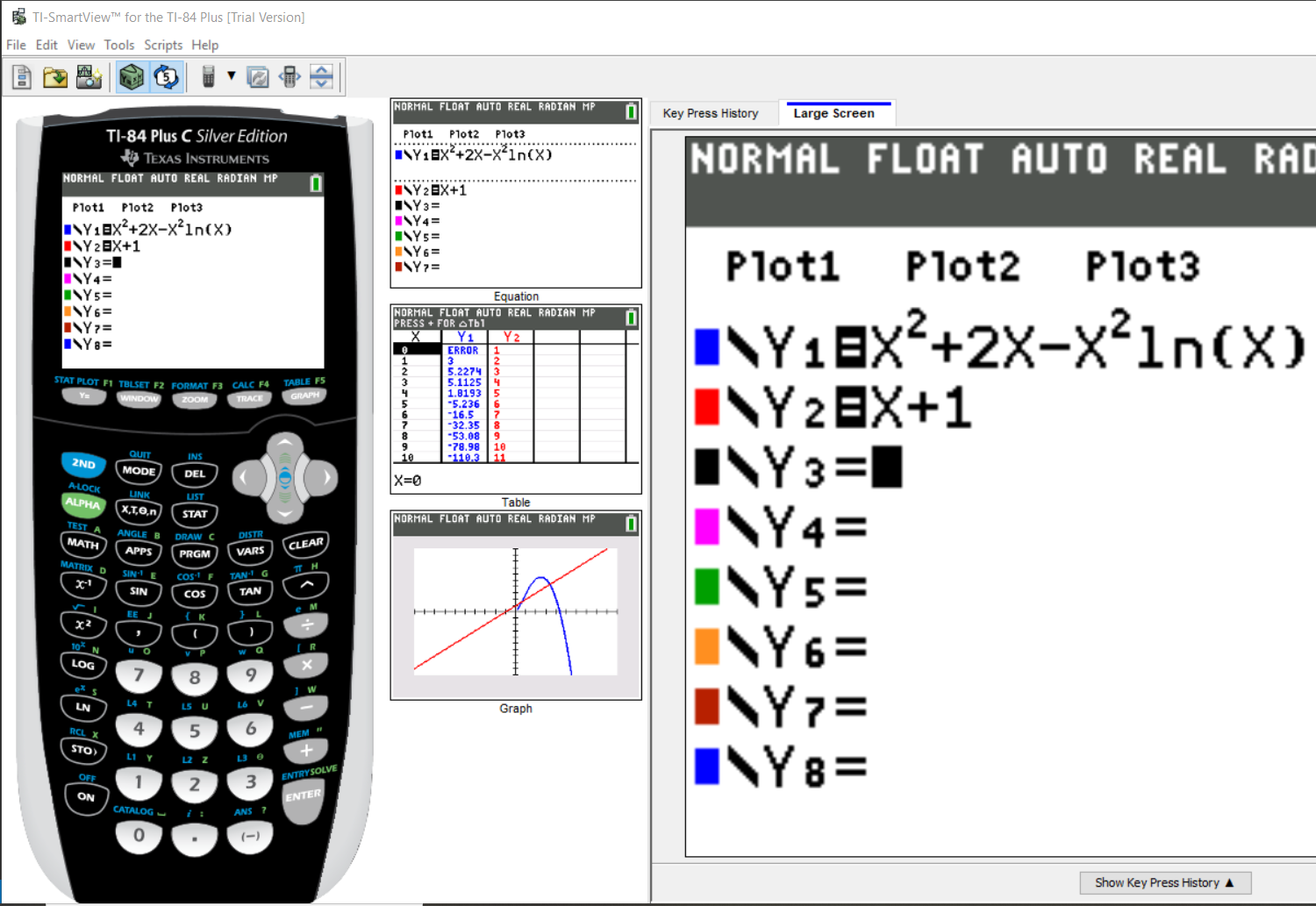
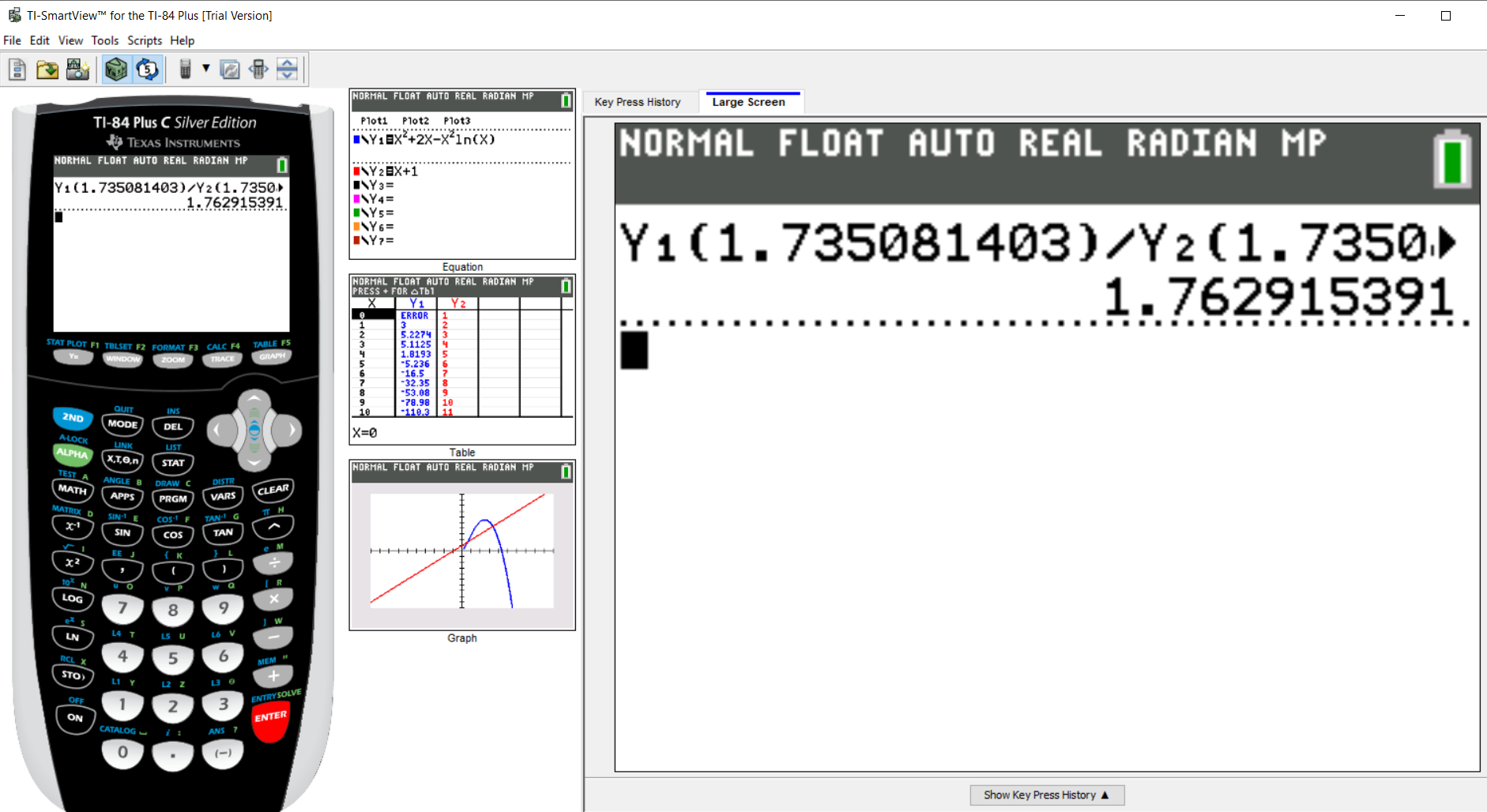
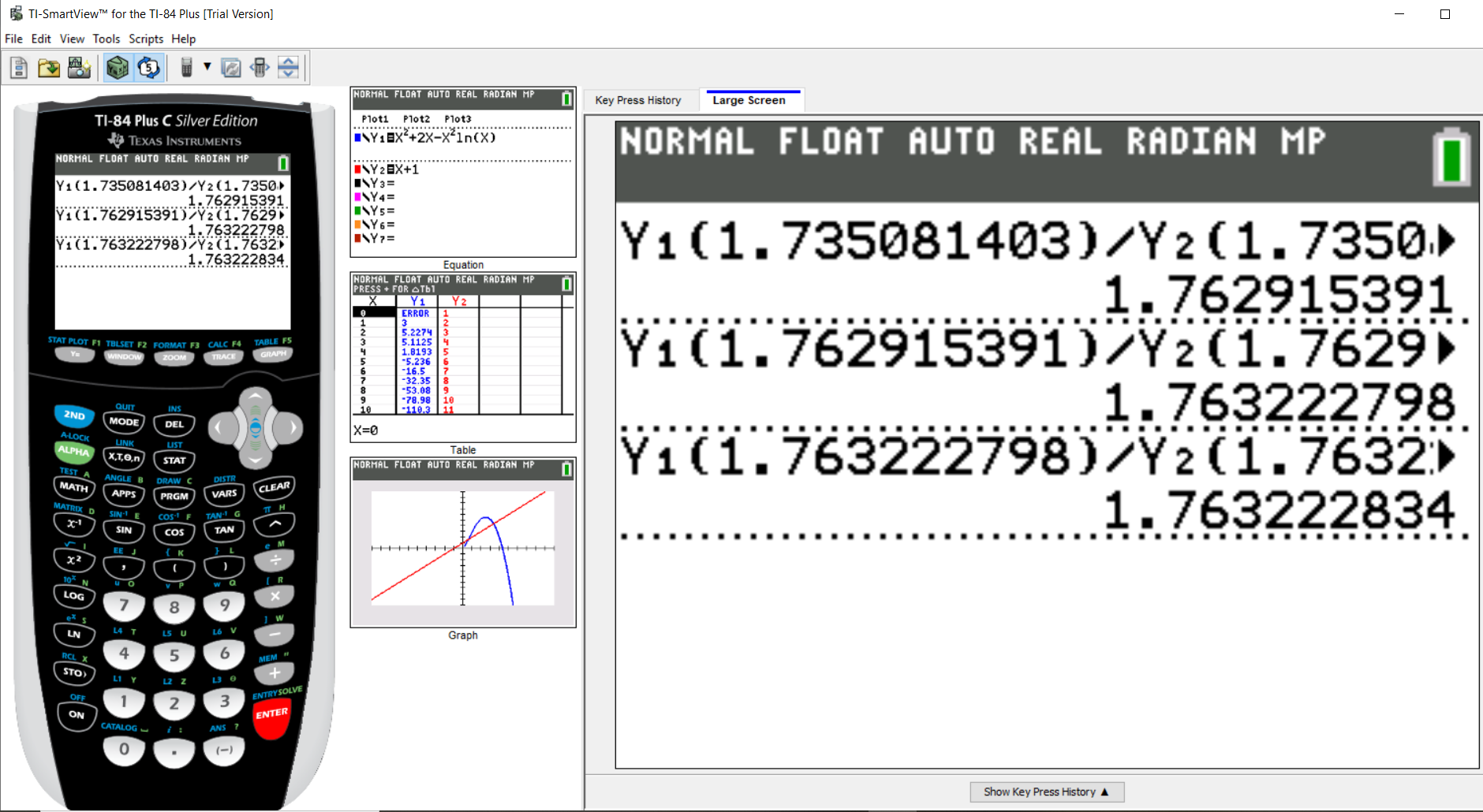
$ (a.) \\[3ex] f(x) = \dfrac{7}{x} - 7\ln(x) \\[5ex] f(x) = 7x^{-1} - 7\ln x \\[3ex] f'(x) = -7x^-2 - \left[7\left(\dfrac{1}{x}\right) + \ln x(0)\right] \\[5ex] f'(x) = -7x^{-2} - \dfrac{7}{x} \\[5ex] f'(x) = \dfrac{-7}{x^2} - \dfrac{7}{x} \\[5ex] Simplify\;\;f(x)\;\;and\;\;f'(x) \\[3ex] f(x) = \dfrac{7}{x} - 7\ln(x) \\[5ex] f(x) = \dfrac{7 - 7x\ln x}{x} \\[5ex] f'(x) = \dfrac{-7}{x^2} - \dfrac{7}{x} \\[5ex] f'(x) = \dfrac{-7 - 7x}{x^2} \\[5ex] \dfrac{f(x)}{f'(x)} \\[5ex] = f(x) \div f'(x) \\[3ex] = \dfrac{7 - 7x\ln x}{x} \div \dfrac{-7 - 7x}{x^2} \\[5ex] = \dfrac{7 - 7x\ln x}{x} * \dfrac{x^2}{-7 - 7x} \\[5ex] = \dfrac{7(1 - x\ln x)}{x} * \dfrac{x^2}{-7(1 + x)} \\[5ex] = \dfrac{x(1 - x\ln x)}{-(1 + x)} \\[5ex] = \dfrac{x - x^2\ln x}{-(1 + x)} \\[5ex] = -\dfrac{(x - x^2\ln x)}{1 + x} \\[5ex] = \dfrac{-x + x^2\ln x}{x + 1} \\[5ex] = \dfrac{x^2\ln x - x}{x + 1} \\[5ex] x - \dfrac{f(x)}{f'(x)} \\[5ex] = x - \dfrac{x^2\ln x - x}{x + 1} \\[5ex] = \dfrac{x(x + 1) - (x^2\ln x - x)}{x + 1} \\[5ex] = \dfrac{x^2 + x - x^2\ln x + x}{x + 1} \\[5ex] = \dfrac{x^2 + 2x - x^2\ln x}{x + 1} \\[5ex] x_{n + 1} = x_n - \dfrac{f(x)}{f'(x)} \\[5ex] \implies \\[3ex] x_{n + 1} = \dfrac{x_n^2 + 2x_n - x_n^2\ln x_n}{x_n + 1} \\[5ex] x_1 = 1 \\[3ex] \implies \\[3ex] x_2 = \dfrac{x_1^2 + 2x_1 - x_1^2\ln x_1}{x_1 + 1} \\[5ex] x_2 = \dfrac{1^2 + 2(1) - 1^2 * \ln(1)}{1 + 1} \\[5ex] x_2 = \dfrac{1 + 2 - 1 * 0}{2} \\[5ex] x_2 = \dfrac{1 + 2 - 0}{2} \\[5ex] x_2 = \dfrac{3}{2} \\[7ex] x_3 = \dfrac{x_2^2 + 2x_2 - x_2^2\ln x_2}{x_2 + 1} \\[5ex] \underline{Numerator} \\[3ex] x_2^2 + 2x_2 - x_2^2\ln x_2 \\[3ex] = \left(\dfrac{3}{2}\right)^2 + 2 * \dfrac{3}{2} - \left(\dfrac{3}{2}\right)^2 * \ln \left(\dfrac{3}{2}\right) \\[5ex] = \dfrac{9}{4} + 3 - \dfrac{9}{4} * \ln \left(\dfrac{3}{2}\right) \\[5ex] = \dfrac{21}{4} - \dfrac{9}{4} * \ln \left(\dfrac{3}{2}\right) \\[5ex] \underline{Denominator} \\[3ex] x_2 + 1 \\[3ex] = \dfrac{3}{2} + 1 \\[5ex] = \dfrac{3 + 2}{2} \\[5ex] = \dfrac{5}{2} \\[5ex] Numerator \div Denominator \\[3ex] = \dfrac{21}{4} - \dfrac{9}{4} * \ln \left(\dfrac{3}{2}\right) \div \dfrac{5}{2} \\[5ex] = \dfrac{1}{4}\left[21 - 9\ln\left(\dfrac{3}{2}\right)\right] * \dfrac{2}{5} \\[5ex] = \dfrac{1}{10}\left[21 - 9\ln\left(\dfrac{3}{2}\right)\right] \\[5ex] = \dfrac{21}{10} - \dfrac{9}{10}\ln\left(\dfrac{3}{2}\right) \\[5ex] \therefore x_3 = \dfrac{21}{10} - \dfrac{9}{10}\ln\left(\dfrac{3}{2}\right) \\[5ex] (b.) \\[3ex] x_3 = 2.1 - (0.9 * \ln(1.5)) \\[3ex] x_3 = 1.735081403 \\[3ex] $ Number 29-1

Number 29-2

$ x_4 = 1.762915391 \\[3ex] $
Number 29-3

$ x_5 = 1.763222798 \\[3ex] x_6 = 1.763222834 \\[3ex] Because\;\;x_5 \approx x_6...STOP $
(30.) If $x f(x) = 3[f(x)]^2 + 2$, then $\displaystyle\int \dfrac{2x^2 - 12\cdot f(x) + f(x)}{[6f(x) - x][x^2 - f(x)]^2} dx$ is equal to

$ (A.)\;\; \dfrac{1}{x^2 - f(x)} + C \\[5ex] (B.)\;\; \dfrac{1}{x^2 + xf(x)} + C \\[5ex] (C.)\;\; \dfrac{1}{[x - f(x)]^2} + C \\[5ex] (D.)\;\; \dfrac{1}{[6f(x) - x]^2} + C \\[5ex] $

This is not a straightforward integration problem
So, we need to see what we can do to simplify the integrand
Let us begin with the function we were given
Let us differentiate that function.

$ x f(x) = 3[f(x)]^2 + 2 \\[3ex] \text{Differentiating the function implicitly, we have} \\[3ex] xf'(x) + f(x)(1) = 3[f(x)f'(x) + f(x)f'(x)] + [f(x)]^2(0) + 0 \\[3ex] xf'(x) + f(x) = 3[2f(x)f'(x)] \\[3ex] xf'(x) + f(x) = 6f(x)f'(x) \\[3ex] f(x) = 6f(x)f'(x) - xf'(x) \\[3ex] f(x) = f'(x)[6f(x) - x] ...eqn.(1) \\[3ex] $ We notice that this modified function is one of the denominators of the integrand.
So, we see some ray of hope in simplifying the integrand
Let us dive back to the numerator of the integrand

$ \underline{\text{Numerator of the integrand}} \\[3ex] 2x^2 - 12\cdot f(x) + f(x) \\[3ex] 2x[x - 6f(x)] + f(x) \\[3ex] \text{Rewrite the first term; Substitute for the 2nd term from eqn.(1)} \\[3ex] -2x[-x + 6f(x)] + f'(x)[6f(x) - x] \\[3ex] -2x[6f(x) - x] + f'(x)[6f(x) - x] \\[3ex] [6f(x) - x][-2x + f'(x)] \\[3ex] [6f(x) - x][f'(x) - 2x] \\[3ex] $ Okay, something can cancel out from the numerator and the denominator of the integrand
Let's continue

$ \displaystyle\int \dfrac{2x^2 - 12\cdot f(x) + f(x)}{[6f(x) - x][x^2 - f(x)]^2} dx \\[5ex] = \displaystyle\int \dfrac{[6f(x) - x][f'(x) - 2x]}{[6f(x) - x][x^2 - f(x)]^2} dx \\[5ex] = \displaystyle\int \dfrac{f'(x) - 2x}{[x^2 - f(x)]^2} dx \\[5ex] \underline{\text{Integration by Algebraic Substitution}} \\[3ex] \text{Let } p = x^2 - f(x) \\[3ex] \dfrac{dp}{dx} = 2x - f'(x) \\[5ex] \dfrac{dx}{dp} = \dfrac{1}{2x - f'(x)} \\[5ex] dx = \dfrac{dp}{2x - f'(x)} \\[5ex] \implies \\[3ex] \displaystyle\int \dfrac{f'(x) - 2x}{p^2} * \dfrac{dp}{2x - f'(x)} \\[5ex] = \displaystyle\int \dfrac{-[f'(x) - 2x] * dp}{-p^2 * [2x - f'(x)]} \\[5ex] = \displaystyle\int \dfrac{[2x - f'(x)] * dp}{-p^2 * [2x - f'(x)]} \\[5ex] = -\displaystyle\int \dfrac{dp}{p^2} \\[5ex] = -\displaystyle\int p^{-2} dp \\[3ex] = \dfrac{-p^{-1}}{-1} + C \\[5ex] = \dfrac{1}{p} + C \\[5ex] = \dfrac{1}{x^2 - f(x)} + C...\text{Option (A.)} $
(31.)


(32.)


(33.)


(34.)


(35.) Show that $\displaystyle\int_{-1}^0 3\ln(2x + 3) dx = \dfrac{3}{2}(\ln 27 - 2)$
Show all work.


$ \underline{\text{From the LHS}} \\[3ex] \displaystyle\int_{-1}^0 3\ln(2x + 3) dx \\[3ex] \underline{\text{Integration by Parts}} \\[3ex] \displaystyle\int udv = uv - \displaystyle\int vdu \\[3ex] \text{Let } u = \ln(2x + 3) \hspace{4em} dv = 3dx \\[3ex] ................................................................ \\[3ex] u = \ln(2x + 3) \\[3ex] \underline{\text{Differentiation by Chain Rule}} \\[3ex] \text{Let }p = 3x + 3 \hspace{4em} u = \ln p \\[3ex] \dfrac{dp}{dx} = 2 \hspace{6em} \dfrac{du}{dp} = \dfrac{1}{p} \\[5ex] \dfrac{du}{dx} = \dfrac{du}{dp} * \dfrac{dp}{dx} ...\text{Chain Rule} \\[5ex] = 2 * \dfrac{1}{p} \\[5ex] = \dfrac{2}{p} \\[5ex] = \dfrac{2}{2x + 3} \\[5ex] ................................................................ \\[3ex] dv = 3dx \\[3ex] \displaystyle\int dv = \displaystyle\int 3dx \\[3ex] v = 3x \\[3ex] ................................................................ \\[3ex] \implies \\[3ex] \displaystyle\int 3\ln(2x + 3) dx \\[3ex] = 3x\ln(2x + 3) - \displaystyle\int 3x * \dfrac{2}{2x + 3} \\[5ex] = 3x\ln(2x + 3) - \displaystyle\int \dfrac{6x}{2x + 3} dx \\[5ex] ................................................................ \\[3ex] \displaystyle\int \dfrac{6x}{2x + 3} dx \\[5ex] \underline{\text{Integration by Algebraic Substitution}} \\[3ex] \text{Let } k = 2x + 3 \\[3ex] 2x = k - 3 \\[3ex] x = \dfrac{k - 3}{2} \\[5ex] Also: \\[3ex] \dfrac{dk}{dx} = 2 \\[5ex] dx = \dfrac{dk}{2} \\[5ex] ................................................................ \\[3ex] \implies \\[3ex] \displaystyle\int \dfrac{6x}{2x + 3} \\[5ex] = \displaystyle\int 6x * \dfrac{1}{2x + 3} dx \\[5ex] = \displaystyle\int 6\left(\dfrac{k - 3}{2}\right) * \dfrac{1}{k} * \dfrac{dk}{2} \\[5ex] = \displaystyle\int \dfrac{3(k - 3)}{2k} dk \\[5ex] = \displaystyle\int \left(\dfrac{3k - 9}{2k}\right) dk \\[5ex] = \displaystyle\int \dfrac{3k}{2k} dk - \displaystyle\int \dfrac{9}{2k} dk \\[5ex] = \dfrac{3}{2}\displaystyle\int dk - \dfrac{9}{2}\ln k \\[5ex] = \dfrac{3k}{2} - \dfrac{9\ln(2x + 3)}{2} \\[5ex] = \dfrac{3(2x + 3)}{2} - \dfrac{9\ln(2x + 3)}{2} \\[5ex] = \dfrac{6x}{2} + \dfrac{9}{2} - \dfrac{9\ln(2x + 3)}{2} \\[5ex] = 3x - \dfrac{9\ln(2x + 3)}{2} \\[5ex] \implies \\[3ex] \displaystyle\int 3\ln(2x + 3) dx \\[3ex] = 3x\ln(2x + 3) - \left[3x + \dfrac{9}{2} - \dfrac{9\ln(2x + 3)}{2}\right] + C \\[5ex] = 3x\ln(2x + 3) - 3x - \dfrac{9}{2} + \dfrac{9\ln(2x + 3)}{2} + C \\[5ex] = 3x\ln(2x + 3) - 3x + \dfrac{9\ln(2x + 3)}{2} - \dfrac{9}{2} + C \\[5ex] = 3x\ln(2x + 3) - 3x + \dfrac{9\ln(2x + 3)}{2} + C \\[5ex] \implies \\[3ex] \displaystyle\int_{-1}^0 3\ln(2x + 3) dx \\[3ex] = \left[3x\ln(2x + 3) - 3x + \dfrac{9\ln(2x + 3)}{2}\right]_{-1}^0 \\[5ex] = \left[3(0)\ln[2(0) + 3] - 3(0) + \dfrac{9\ln[2(0) + 3]}{2}\right] - \left[3(-1)\ln[2(-1) + 3] - 3(-1) + \dfrac{9\ln[2(-1) + 3]}{2}\right] \\[5ex] = \left(0 - 0 + \dfrac{9\ln 3}{2}\right) - \left[-3\ln 1 + 3 + \dfrac{9\ln 1}{2}\right] \\[5ex] = \dfrac{9\ln 3}{2} - \left[-3(0) + 3 + \dfrac{9(0)}{2}\right] \\[5ex] = \dfrac{9\ln 3}{2} - (0 + 3 + 0) \\[5ex] = \dfrac{9\ln 3}{2} - 3 \\[5ex] = \dfrac{3}{2}(3\ln 3 - 2) \\[5ex] = \dfrac{3}{2}(\ln 3^3 - 2) \\[5ex] = \dfrac{3}{2}(\ln 27 - 2) \\[5ex] = RHS $
(36.)


(37.)


(38.)


(39.)


(40.)


© 2019   SamDom4Peace Designs.