Solved Examples: Applications of Derivatives
(25.) NSC The graph of $h(x) = ax^3 + bx^2$ is drawn.
The graph has turning points at the origin, O(0 ; 0) and B(4 ; 32)
A is an x-intercept of h
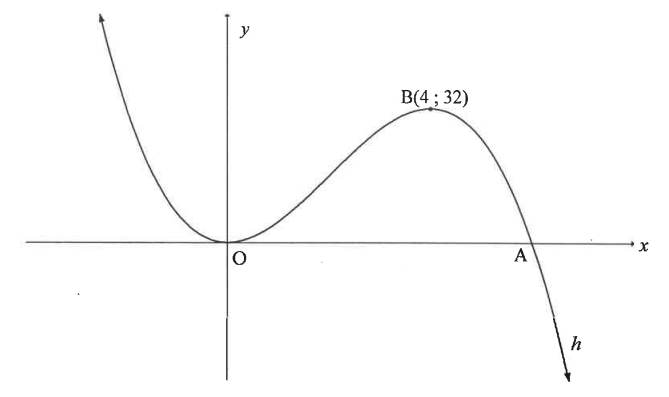
(25.1) Show that a = −1 and b = 6
(25.2) Calculate the coordinates of A
(25.3) Write down the values of x for which h is:
(25.3.1) Increasing
(25.3.2) Concave down
(25.4) For which values of k will $-(x - 1)^3 + 6(x - 1)^2 - k = 0$ have one negative and two distinct positive roots?
$ (25.1) \\[3ex] Function:\;\;h(x) = ax^3 + bx^2 \\[3ex] For\;\;Point\;B(4, 32) \\[3ex] x = 4 \\[3ex] y = h(x) = 32 \\[3ex] \implies \\[3ex] 32 = a(4)^3 + b(4)^2 \\[3ex] 32 = 64a + 16b \\[3ex] 64a + 16b = 32 \\[3ex] \implies \\[3ex] 4a + b = 2 ...eqn.(1) \\[3ex] Also: \\[3ex] h(x) = ax^3 + bx^2 \\[3ex] h'(x) = 3ax^2 + 2bx \\[3ex] At\;\;turning\;\;point,\;\;h'(x) = 0 \\[3ex] For\;\;Turning\;\;Point\;B(4, 32) \\[3ex] x = 4 \\[3ex] \implies \\[3ex] h'(4) = 0 \\[3ex] h'(4) = 3a(4)^2 + 2b(4) = 0 \\[3ex] 48a + 8b = 0 \\[3ex] \implies \\[3ex] 6a + b = 0 ...eqn.(2) \\[3ex] eqn.(2) - eqn.(1) \\[3ex] 6a - 4a = 0 - 2 \\[3ex] 2a = -2 \\[3ex] a = -\dfrac{2}{2} \\[5ex] a = -1 \\[3ex] Substitute\;\;a = -1 \;\;into\;\;eqn.(1) \\[3ex] 4(-1) + b = 2 \\[3ex] -4 + b = 2 \\[3ex] b = 2 + 4 \\[3ex] b = 6 \\[3ex] \therefore h(x) = -x^3 + 6x^2 \\[3ex] (25.2) \\[3ex] A = x-intercept\;\;of\;\;h(x) \\[3ex] \implies \\[3ex] h(x) = 0 \\[3ex] -x^3 + 6x^2 = 0 \\[3ex] x^2(-x + 6) = 0 \\[3ex] x^2 = 0 \;\;\;OR\;\;\; -x + 6 = 0 \\[3ex] x = \pm \sqrt{0} \;\;\;OR\;\;\; 6 = 0 + x \\[3ex] x = \pm 0 \;\;\;OR\;\;\; 6 = x \\[3ex] Based\;\;on\;\;the\;\;graph:\;\; x \ne \pm 0 \\[3ex] x = 6 \\[3ex] \therefore coordinates\;\;of\;\;A = (6, 0) \\[3ex] (25.3) \\[3ex] (25.3.1) \\[3ex] Based\;\;on\;\;the\;\;Graph \\[3ex] h(x)\uparrow for\;\; x \in (0, 4) \\[3ex] (25.3.2) \\[3ex] Based\;\;on\;\;the\;\;function \\[3ex] h(x) = -x^3 + 6x^2 \\[3ex] h'(x) = -3x^2 + 12x \\[3ex] h''(x) = -6x + 12 \\[3ex] h''(x) = 0 \\[3ex] \implies \\[3ex] -6x + 12 = 0 \\[3ex] -6x = -12 \\[3ex] x = \dfrac{-12}{-6} \\[5ex] Inflection\;\;Point:\;\;x = 2 \\[3ex] Intervals:\;\; x \lt 2 \;\;and\;\; x \gt 2 \\[3ex] $
$ h(x)\frown for\;\; x \gt 2 \\[3ex] h(x)\frown for\;\; x \in (2, \infty) \\[3ex] (25.4) \\[3ex] -(x - 1)^3 + 6(x - 1)^2 - k = 0 \\[3ex] -(x - 1)^3 + 6(x - 1)^2 = k \\[3ex] k = -(x - 1)^3 + 6(x - 1)^2 \\[3ex] h(x) = -x^3 + 6x^2 \\[3ex] h(x - 1) = -(x - 1)^3 + 6(x - 1)^2 \\[3ex] \implies k = h(x - 1) \\[3ex] k = graph\;\;of\;\;h(x - 1) \\[3ex] 1st\;\;find\;\;the\;\;y-intercept...value\;\;of\;\;k\;\;when\;\;x = 0 \\[3ex] k = -(0 - 1)^3 + 6(0 - 1)^2 \\[3ex] k = -(-1)^3 + 6(-1)^2 \\[3ex] k = -(-1) + 6(1) \\[3ex] k = 1 + 6 \\[3ex] k = 7 \\[3ex] Negative\;\;root \implies x \lt 0 \\[3ex] When\;\;x \lt 0,\;\;k \lt 7 \\[3ex] Let\;\;us\;\;find\;\;the\;\;maximum\;\;value\;\;for\;\;the\;\;positive\;\;roots \\[3ex] h(x - 1) = -(x - 1)^3 + 6(x - 1)^2 \\[3ex] h(x - 1)' = -3(x - 1)^2 + 12(x - 1) \\[3ex] h(x - 1)' = 0 \\[3ex] \implies \\[3ex] -3(x - 1)^2 + 12(x - 1) = 0 \\[3ex] -3(x^2 - 2x + 1) + 12x - 12 = 0 \\[3ex] -3x^2 + 6x - 3 + 12x - 12 = 0 \\[3ex] -3x^2 + 18x - 15 = 0 \\[3ex] x^2 - 6x + 5 = 0 \\[3ex] (x - 5)(x - 1) = 0 \\[3ex] x - 5 = 0 \;\;\;OR\;\;\; x - 1 = 0 \\[3ex] x = 5 \;\;\;OR\;\;\; x = 1 \\[3ex] For\;\;x = 5 \\[3ex] h(x - 1) = -(5 - 1)^3 + 6(5 - 1)^2 \\[3ex] = -4^3 + 6(4^2) \\[3ex] = -64 + 6(16) \\[3ex] = -64 + 96 \\[3ex] = 32 \\[3ex] For\;\;x = 1 \\[3ex] h(x - 1) = -(1 - 1)^3 + 6(0 - 1)^2 \\[3ex] = -0^3 + 6(-1)^2 \\[3ex] = 0 + 6(1) \\[3ex] = 0 + 6 \\[3ex] = 6 \\[3ex] Maximum\;\;value = 32 \\[3ex] \implies \\[3ex] 7 \lt k \lt 32 $
The graph has turning points at the origin, O(0 ; 0) and B(4 ; 32)
A is an x-intercept of h
(25.1) Show that a = −1 and b = 6
(25.2) Calculate the coordinates of A
(25.3) Write down the values of x for which h is:
(25.3.1) Increasing
(25.3.2) Concave down
(25.4) For which values of k will $-(x - 1)^3 + 6(x - 1)^2 - k = 0$ have one negative and two distinct positive roots?
$ (25.1) \\[3ex] Function:\;\;h(x) = ax^3 + bx^2 \\[3ex] For\;\;Point\;B(4, 32) \\[3ex] x = 4 \\[3ex] y = h(x) = 32 \\[3ex] \implies \\[3ex] 32 = a(4)^3 + b(4)^2 \\[3ex] 32 = 64a + 16b \\[3ex] 64a + 16b = 32 \\[3ex] \implies \\[3ex] 4a + b = 2 ...eqn.(1) \\[3ex] Also: \\[3ex] h(x) = ax^3 + bx^2 \\[3ex] h'(x) = 3ax^2 + 2bx \\[3ex] At\;\;turning\;\;point,\;\;h'(x) = 0 \\[3ex] For\;\;Turning\;\;Point\;B(4, 32) \\[3ex] x = 4 \\[3ex] \implies \\[3ex] h'(4) = 0 \\[3ex] h'(4) = 3a(4)^2 + 2b(4) = 0 \\[3ex] 48a + 8b = 0 \\[3ex] \implies \\[3ex] 6a + b = 0 ...eqn.(2) \\[3ex] eqn.(2) - eqn.(1) \\[3ex] 6a - 4a = 0 - 2 \\[3ex] 2a = -2 \\[3ex] a = -\dfrac{2}{2} \\[5ex] a = -1 \\[3ex] Substitute\;\;a = -1 \;\;into\;\;eqn.(1) \\[3ex] 4(-1) + b = 2 \\[3ex] -4 + b = 2 \\[3ex] b = 2 + 4 \\[3ex] b = 6 \\[3ex] \therefore h(x) = -x^3 + 6x^2 \\[3ex] (25.2) \\[3ex] A = x-intercept\;\;of\;\;h(x) \\[3ex] \implies \\[3ex] h(x) = 0 \\[3ex] -x^3 + 6x^2 = 0 \\[3ex] x^2(-x + 6) = 0 \\[3ex] x^2 = 0 \;\;\;OR\;\;\; -x + 6 = 0 \\[3ex] x = \pm \sqrt{0} \;\;\;OR\;\;\; 6 = 0 + x \\[3ex] x = \pm 0 \;\;\;OR\;\;\; 6 = x \\[3ex] Based\;\;on\;\;the\;\;graph:\;\; x \ne \pm 0 \\[3ex] x = 6 \\[3ex] \therefore coordinates\;\;of\;\;A = (6, 0) \\[3ex] (25.3) \\[3ex] (25.3.1) \\[3ex] Based\;\;on\;\;the\;\;Graph \\[3ex] h(x)\uparrow for\;\; x \in (0, 4) \\[3ex] (25.3.2) \\[3ex] Based\;\;on\;\;the\;\;function \\[3ex] h(x) = -x^3 + 6x^2 \\[3ex] h'(x) = -3x^2 + 12x \\[3ex] h''(x) = -6x + 12 \\[3ex] h''(x) = 0 \\[3ex] \implies \\[3ex] -6x + 12 = 0 \\[3ex] -6x = -12 \\[3ex] x = \dfrac{-12}{-6} \\[5ex] Inflection\;\;Point:\;\;x = 2 \\[3ex] Intervals:\;\; x \lt 2 \;\;and\;\; x \gt 2 \\[3ex] $
| Interval | $x \lt 2$ | $x \gt 2$ |
| Test Value | $x = 1$ | $x = 3$ |
| Sign Test | $$ -6(1) + 12 \\[3ex] -6 + 12 = 6 \\[3ex] 6 \gt 0 \\[3ex] positive $$ | $$ -6(3) + 12 \\[3ex] -18 + 12 = -6 \\[3ex] -6 \lt 0 \\[3ex] negative $$ |
| Conclusion | Concave up | Concave down |
$ h(x)\frown for\;\; x \gt 2 \\[3ex] h(x)\frown for\;\; x \in (2, \infty) \\[3ex] (25.4) \\[3ex] -(x - 1)^3 + 6(x - 1)^2 - k = 0 \\[3ex] -(x - 1)^3 + 6(x - 1)^2 = k \\[3ex] k = -(x - 1)^3 + 6(x - 1)^2 \\[3ex] h(x) = -x^3 + 6x^2 \\[3ex] h(x - 1) = -(x - 1)^3 + 6(x - 1)^2 \\[3ex] \implies k = h(x - 1) \\[3ex] k = graph\;\;of\;\;h(x - 1) \\[3ex] 1st\;\;find\;\;the\;\;y-intercept...value\;\;of\;\;k\;\;when\;\;x = 0 \\[3ex] k = -(0 - 1)^3 + 6(0 - 1)^2 \\[3ex] k = -(-1)^3 + 6(-1)^2 \\[3ex] k = -(-1) + 6(1) \\[3ex] k = 1 + 6 \\[3ex] k = 7 \\[3ex] Negative\;\;root \implies x \lt 0 \\[3ex] When\;\;x \lt 0,\;\;k \lt 7 \\[3ex] Let\;\;us\;\;find\;\;the\;\;maximum\;\;value\;\;for\;\;the\;\;positive\;\;roots \\[3ex] h(x - 1) = -(x - 1)^3 + 6(x - 1)^2 \\[3ex] h(x - 1)' = -3(x - 1)^2 + 12(x - 1) \\[3ex] h(x - 1)' = 0 \\[3ex] \implies \\[3ex] -3(x - 1)^2 + 12(x - 1) = 0 \\[3ex] -3(x^2 - 2x + 1) + 12x - 12 = 0 \\[3ex] -3x^2 + 6x - 3 + 12x - 12 = 0 \\[3ex] -3x^2 + 18x - 15 = 0 \\[3ex] x^2 - 6x + 5 = 0 \\[3ex] (x - 5)(x - 1) = 0 \\[3ex] x - 5 = 0 \;\;\;OR\;\;\; x - 1 = 0 \\[3ex] x = 5 \;\;\;OR\;\;\; x = 1 \\[3ex] For\;\;x = 5 \\[3ex] h(x - 1) = -(5 - 1)^3 + 6(5 - 1)^2 \\[3ex] = -4^3 + 6(4^2) \\[3ex] = -64 + 6(16) \\[3ex] = -64 + 96 \\[3ex] = 32 \\[3ex] For\;\;x = 1 \\[3ex] h(x - 1) = -(1 - 1)^3 + 6(0 - 1)^2 \\[3ex] = -0^3 + 6(-1)^2 \\[3ex] = 0 + 6(1) \\[3ex] = 0 + 6 \\[3ex] = 6 \\[3ex] Maximum\;\;value = 32 \\[3ex] \implies \\[3ex] 7 \lt k \lt 32 $
(29.) The function: $f(x) = \dfrac{7}{x} - 7\ln(x)$ has a root on [1, 2]
(a.) Choosing $x_1 = 1$, determine the exact value of the third approximation, $x_3$ for the root via Newton's method.
(b.) Then, continue to find the root, correct to 5 decimal places, for comparison.
$ (a.) \\[3ex] f(x) = \dfrac{7}{x} - 7\ln(x) \\[5ex] f(x) = 7x^{-1} - 7\ln x \\[3ex] f'(x) = -7x^-2 - \left[7\left(\dfrac{1}{x}\right) + \ln x(0)\right] \\[5ex] f'(x) = -7x^{-2} - \dfrac{7}{x} \\[5ex] f'(x) = \dfrac{-7}{x^2} - \dfrac{7}{x} \\[5ex] Simplify\;\;f(x)\;\;and\;\;f'(x) \\[3ex] f(x) = \dfrac{7}{x} - 7\ln(x) \\[5ex] f(x) = \dfrac{7 - 7x\ln x}{x} \\[5ex] f'(x) = \dfrac{-7}{x^2} - \dfrac{7}{x} \\[5ex] f'(x) = \dfrac{-7 - 7x}{x^2} \\[5ex] \dfrac{f(x)}{f'(x)} \\[5ex] = f(x) \div f'(x) \\[3ex] = \dfrac{7 - 7x\ln x}{x} \div \dfrac{-7 - 7x}{x^2} \\[5ex] = \dfrac{7 - 7x\ln x}{x} * \dfrac{x^2}{-7 - 7x} \\[5ex] = \dfrac{7(1 - x\ln x)}{x} * \dfrac{x^2}{-7(1 + x)} \\[5ex] = \dfrac{x(1 - x\ln x)}{-(1 + x)} \\[5ex] = \dfrac{x - x^2\ln x}{-(1 + x)} \\[5ex] = -\dfrac{(x - x^2\ln x)}{1 + x} \\[5ex] = \dfrac{-x + x^2\ln x}{x + 1} \\[5ex] = \dfrac{x^2\ln x - x}{x + 1} \\[5ex] x - \dfrac{f(x)}{f'(x)} \\[5ex] = x - \dfrac{x^2\ln x - x}{x + 1} \\[5ex] = \dfrac{x(x + 1) - (x^2\ln x - x)}{x + 1} \\[5ex] = \dfrac{x^2 + x - x^2\ln x + x}{x + 1} \\[5ex] = \dfrac{x^2 + 2x - x^2\ln x}{x + 1} \\[5ex] x_{n + 1} = x_n - \dfrac{f(x)}{f'(x)} \\[5ex] \implies \\[3ex] x_{n + 1} = \dfrac{x_n^2 + 2x_n - x_n^2\ln x_n}{x_n + 1} \\[5ex] x_1 = 1 \\[3ex] \implies \\[3ex] x_2 = \dfrac{x_1^2 + 2x_1 - x_1^2\ln x_1}{x_1 + 1} \\[5ex] x_2 = \dfrac{1^2 + 2(1) - 1^2 * \ln(1)}{1 + 1} \\[5ex] x_2 = \dfrac{1 + 2 - 1 * 0}{2} \\[5ex] x_2 = \dfrac{1 + 2 - 0}{2} \\[5ex] x_2 = \dfrac{3}{2} \\[7ex] x_3 = \dfrac{x_2^2 + 2x_2 - x_2^2\ln x_2}{x_2 + 1} \\[5ex] \underline{Numerator} \\[3ex] x_2^2 + 2x_2 - x_2^2\ln x_2 \\[3ex] = \left(\dfrac{3}{2}\right)^2 + 2 * \dfrac{3}{2} - \left(\dfrac{3}{2}\right)^2 * \ln \left(\dfrac{3}{2}\right) \\[5ex] = \dfrac{9}{4} + 3 - \dfrac{9}{4} * \ln \left(\dfrac{3}{2}\right) \\[5ex] = \dfrac{21}{4} - \dfrac{9}{4} * \ln \left(\dfrac{3}{2}\right) \\[5ex] \underline{Denominator} \\[3ex] x_2 + 1 \\[3ex] = \dfrac{3}{2} + 1 \\[5ex] = \dfrac{3 + 2}{2} \\[5ex] = \dfrac{5}{2} \\[5ex] Numerator \div Denominator \\[3ex] = \dfrac{21}{4} - \dfrac{9}{4} * \ln \left(\dfrac{3}{2}\right) \div \dfrac{5}{2} \\[5ex] = \dfrac{1}{4}\left[21 - 9\ln\left(\dfrac{3}{2}\right)\right] * \dfrac{2}{5} \\[5ex] = \dfrac{1}{10}\left[21 - 9\ln\left(\dfrac{3}{2}\right)\right] \\[5ex] = \dfrac{21}{10} - \dfrac{9}{10}\ln\left(\dfrac{3}{2}\right) \\[5ex] \therefore x_3 = \dfrac{21}{10} - \dfrac{9}{10}\ln\left(\dfrac{3}{2}\right) \\[5ex] (b.) \\[3ex] x_3 = 2.1 - (0.9 * \ln(1.5)) \\[3ex] x_3 = 1.735081403 \\[3ex] $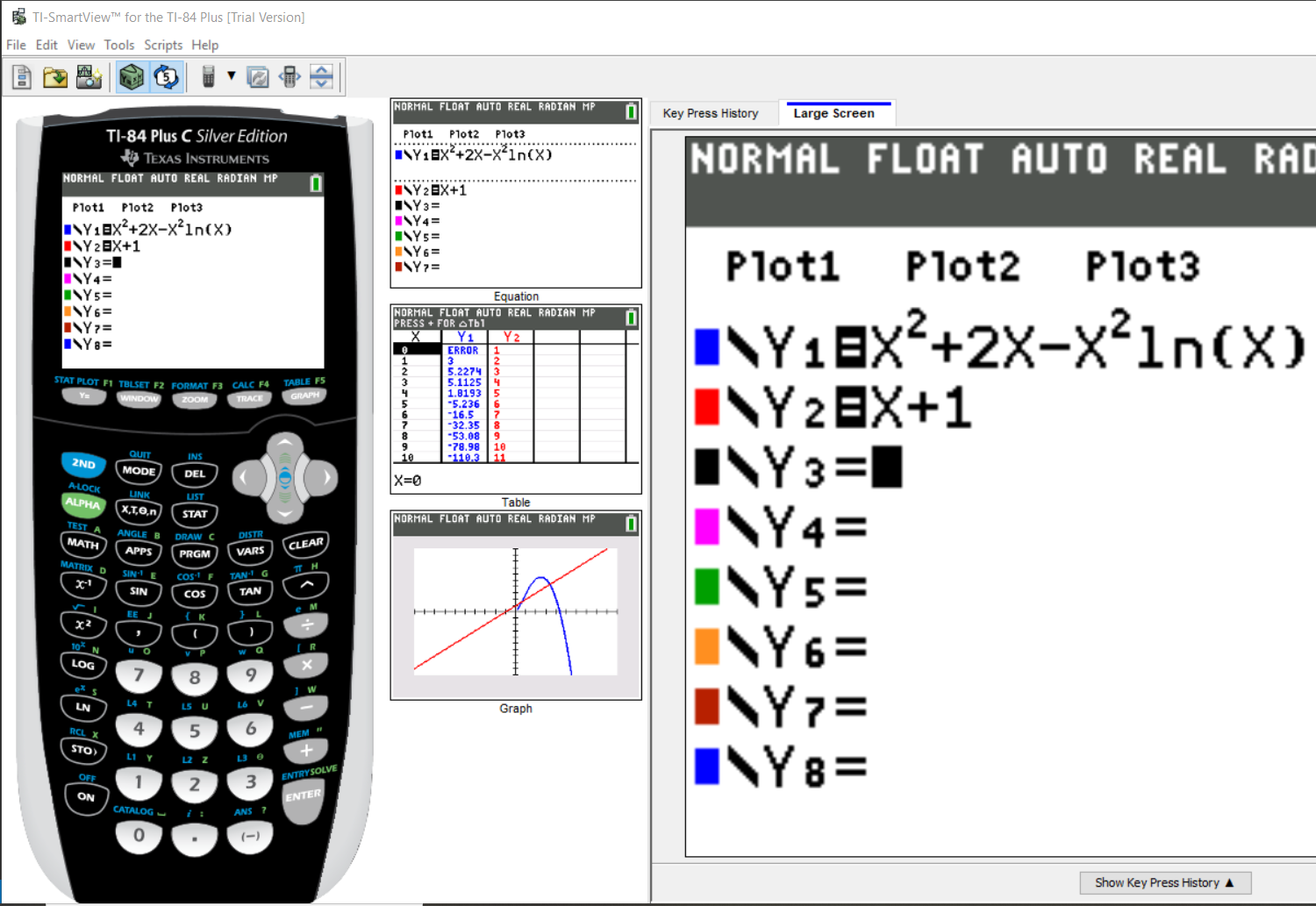
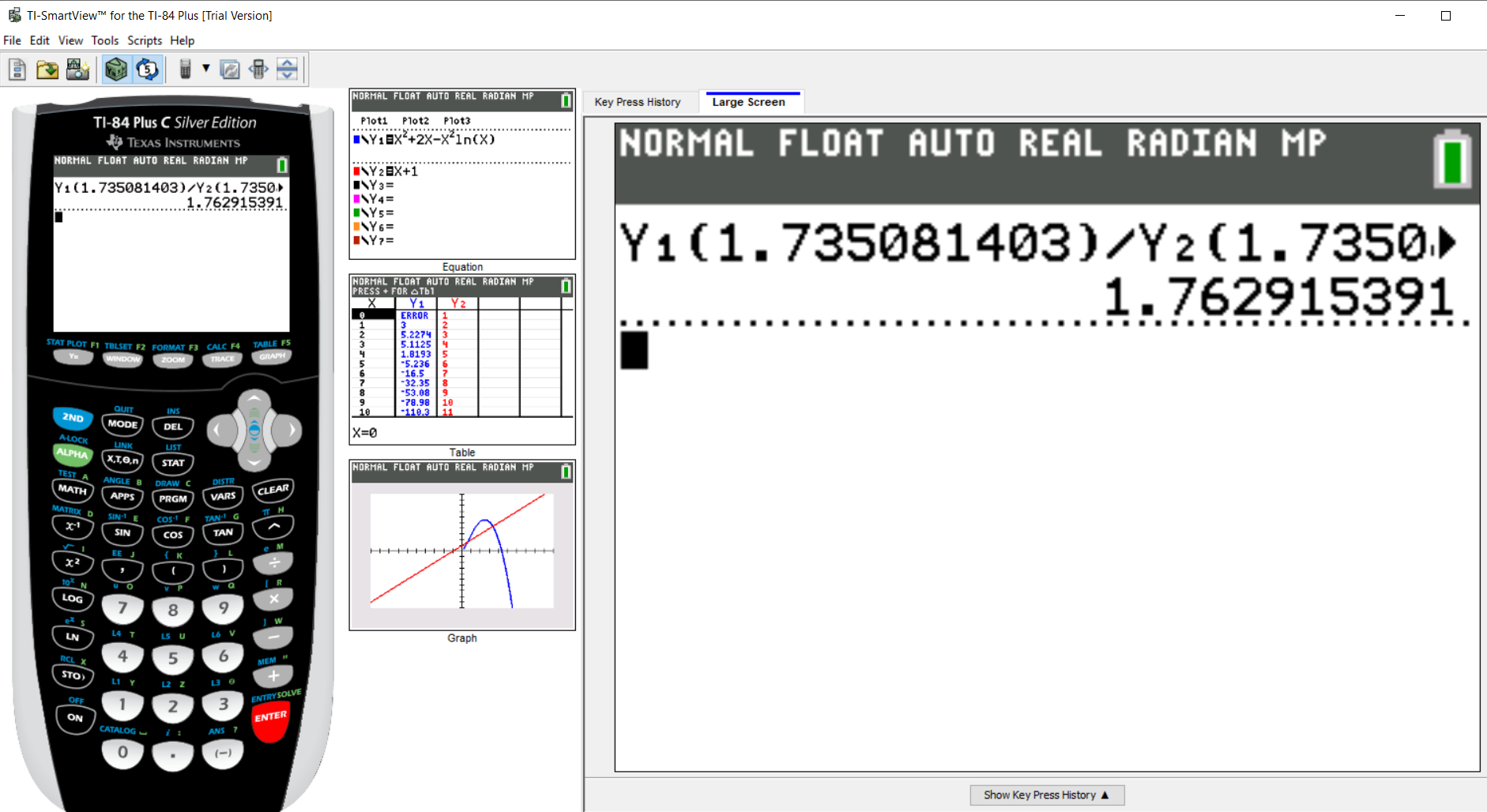
$ x_4 = 1.762915391 \\[3ex] $
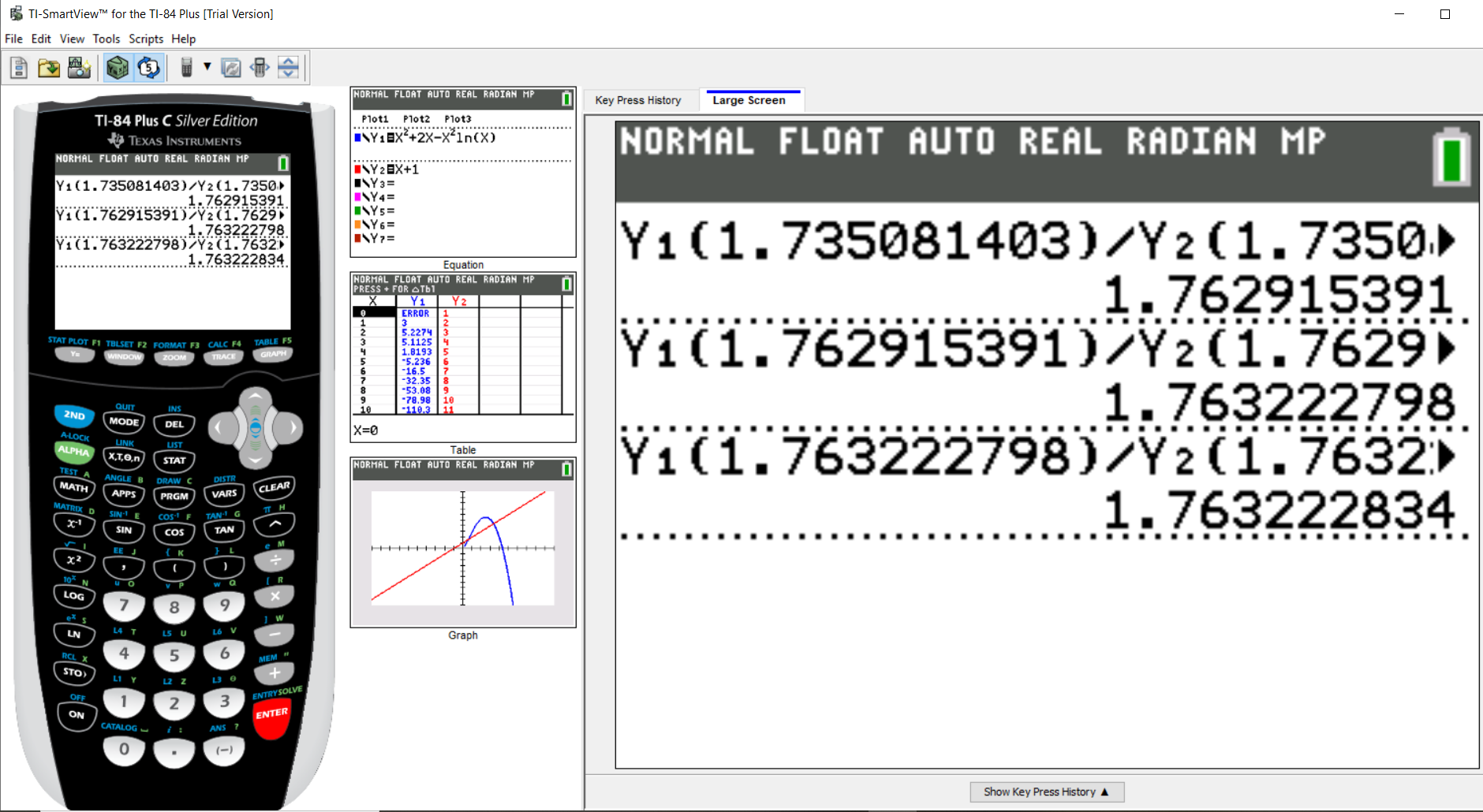
$ x_5 = 1.763222798 \\[3ex] x_6 = 1.763222834 \\[3ex] Because\;\;x_5 \approx x_6...STOP $
(a.) Choosing $x_1 = 1$, determine the exact value of the third approximation, $x_3$ for the root via Newton's method.
(b.) Then, continue to find the root, correct to 5 decimal places, for comparison.
$ (a.) \\[3ex] f(x) = \dfrac{7}{x} - 7\ln(x) \\[5ex] f(x) = 7x^{-1} - 7\ln x \\[3ex] f'(x) = -7x^-2 - \left[7\left(\dfrac{1}{x}\right) + \ln x(0)\right] \\[5ex] f'(x) = -7x^{-2} - \dfrac{7}{x} \\[5ex] f'(x) = \dfrac{-7}{x^2} - \dfrac{7}{x} \\[5ex] Simplify\;\;f(x)\;\;and\;\;f'(x) \\[3ex] f(x) = \dfrac{7}{x} - 7\ln(x) \\[5ex] f(x) = \dfrac{7 - 7x\ln x}{x} \\[5ex] f'(x) = \dfrac{-7}{x^2} - \dfrac{7}{x} \\[5ex] f'(x) = \dfrac{-7 - 7x}{x^2} \\[5ex] \dfrac{f(x)}{f'(x)} \\[5ex] = f(x) \div f'(x) \\[3ex] = \dfrac{7 - 7x\ln x}{x} \div \dfrac{-7 - 7x}{x^2} \\[5ex] = \dfrac{7 - 7x\ln x}{x} * \dfrac{x^2}{-7 - 7x} \\[5ex] = \dfrac{7(1 - x\ln x)}{x} * \dfrac{x^2}{-7(1 + x)} \\[5ex] = \dfrac{x(1 - x\ln x)}{-(1 + x)} \\[5ex] = \dfrac{x - x^2\ln x}{-(1 + x)} \\[5ex] = -\dfrac{(x - x^2\ln x)}{1 + x} \\[5ex] = \dfrac{-x + x^2\ln x}{x + 1} \\[5ex] = \dfrac{x^2\ln x - x}{x + 1} \\[5ex] x - \dfrac{f(x)}{f'(x)} \\[5ex] = x - \dfrac{x^2\ln x - x}{x + 1} \\[5ex] = \dfrac{x(x + 1) - (x^2\ln x - x)}{x + 1} \\[5ex] = \dfrac{x^2 + x - x^2\ln x + x}{x + 1} \\[5ex] = \dfrac{x^2 + 2x - x^2\ln x}{x + 1} \\[5ex] x_{n + 1} = x_n - \dfrac{f(x)}{f'(x)} \\[5ex] \implies \\[3ex] x_{n + 1} = \dfrac{x_n^2 + 2x_n - x_n^2\ln x_n}{x_n + 1} \\[5ex] x_1 = 1 \\[3ex] \implies \\[3ex] x_2 = \dfrac{x_1^2 + 2x_1 - x_1^2\ln x_1}{x_1 + 1} \\[5ex] x_2 = \dfrac{1^2 + 2(1) - 1^2 * \ln(1)}{1 + 1} \\[5ex] x_2 = \dfrac{1 + 2 - 1 * 0}{2} \\[5ex] x_2 = \dfrac{1 + 2 - 0}{2} \\[5ex] x_2 = \dfrac{3}{2} \\[7ex] x_3 = \dfrac{x_2^2 + 2x_2 - x_2^2\ln x_2}{x_2 + 1} \\[5ex] \underline{Numerator} \\[3ex] x_2^2 + 2x_2 - x_2^2\ln x_2 \\[3ex] = \left(\dfrac{3}{2}\right)^2 + 2 * \dfrac{3}{2} - \left(\dfrac{3}{2}\right)^2 * \ln \left(\dfrac{3}{2}\right) \\[5ex] = \dfrac{9}{4} + 3 - \dfrac{9}{4} * \ln \left(\dfrac{3}{2}\right) \\[5ex] = \dfrac{21}{4} - \dfrac{9}{4} * \ln \left(\dfrac{3}{2}\right) \\[5ex] \underline{Denominator} \\[3ex] x_2 + 1 \\[3ex] = \dfrac{3}{2} + 1 \\[5ex] = \dfrac{3 + 2}{2} \\[5ex] = \dfrac{5}{2} \\[5ex] Numerator \div Denominator \\[3ex] = \dfrac{21}{4} - \dfrac{9}{4} * \ln \left(\dfrac{3}{2}\right) \div \dfrac{5}{2} \\[5ex] = \dfrac{1}{4}\left[21 - 9\ln\left(\dfrac{3}{2}\right)\right] * \dfrac{2}{5} \\[5ex] = \dfrac{1}{10}\left[21 - 9\ln\left(\dfrac{3}{2}\right)\right] \\[5ex] = \dfrac{21}{10} - \dfrac{9}{10}\ln\left(\dfrac{3}{2}\right) \\[5ex] \therefore x_3 = \dfrac{21}{10} - \dfrac{9}{10}\ln\left(\dfrac{3}{2}\right) \\[5ex] (b.) \\[3ex] x_3 = 2.1 - (0.9 * \ln(1.5)) \\[3ex] x_3 = 1.735081403 \\[3ex] $
$ x_4 = 1.762915391 \\[3ex] $
$ x_5 = 1.763222798 \\[3ex] x_6 = 1.763222834 \\[3ex] Because\;\;x_5 \approx x_6...STOP $